IMR90 ER:RAS model
IMR90 ER:RAS is a cultured fibroblast model of oncogene-induced senescence (OIS), building on the Serrano–Lowe senescence experiment. Researchers transduce primary IMR90 human fetal lung fibroblasts with a tamoxifen-inducible ER:RAS fusion oncogene. The oncogene remains latent until 4-hydroxytamoxifen (4-OHT) enters the culture medium.
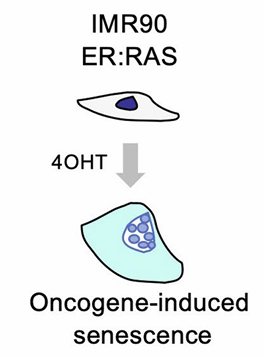
Setup
The baseline IMR90 cells carry a chimeric fusion oncogene construct called ER:RAS, which fuses the HRASG12V oncogene to the ligand-binding domain of a mutant estrogen receptor (ER).
There are 2 states in this model:
- Inducer absent, oncogene inactive: Heat shock proteins (HSPs) bind the ER:RAS fusion protein and keep it inactive in the cytoplasm.
- Inducer present, oncogene active: Adding the inducer 4-hydroxy-tamoxifen (4-OHT) to the culture medium triggers a conformational change in the estrogen receptor, displacing HSPs and activating strong RAS signaling.
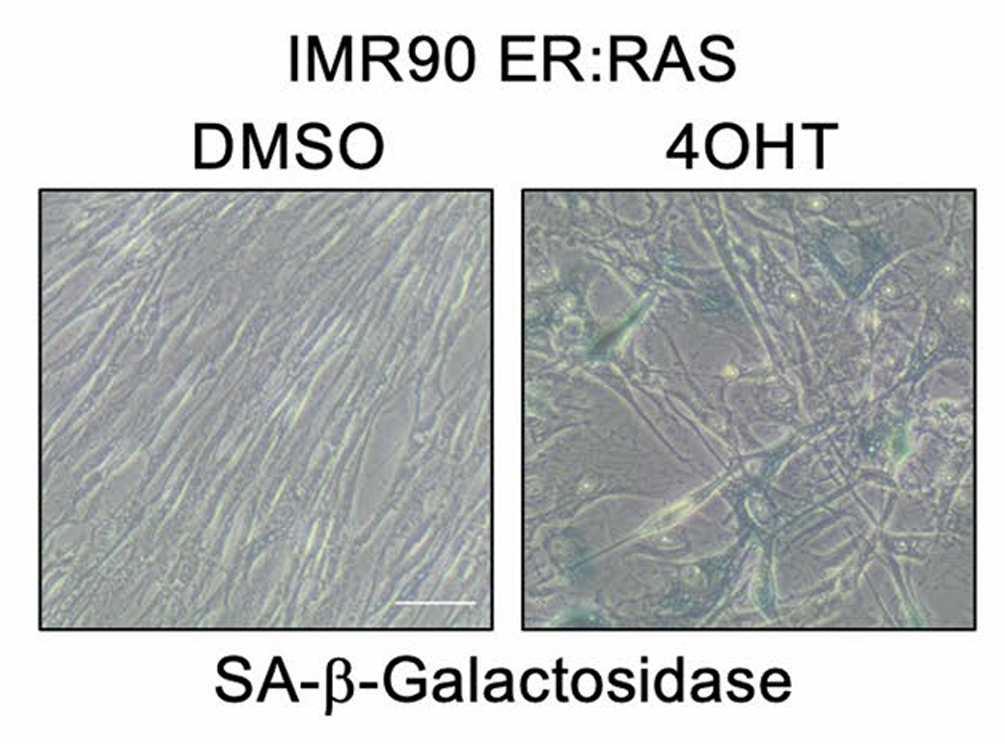
Once 4-OHT is added, the transduced IMR90 cells demonstrate classic senescence markers:
- Irreversible G1 Growth Arrest: Mediated through the synchronous activation of the p53-p21 and p16INK4a-RB tumor suppressor pathways.
- Morphological Changes: Cells flatten, become enlarged, and exhibit a distinct, vacuolated cytoplasm.
- Metabolic Changes: Increased lysosomal activity detectable via positive Senescence-Associated β-Galactosidase (SA-β-gal) staining at pH 6.0.
- SASP Activation: Strong production of the Senescence-Associated Secretory Phenotype, including pro-inflammatory cytokines like IL-6 and IL-8.
- Nuclear Changes: Formation of Senescence-Associated Heterochromatin Foci (SAHF) and persistent DNA damage response (DDR) activation.
Rationale
Primary human fibroblasts do not undergo spontaneous transformation easily and have an intact tumor-suppressor barrier. The system provides:
- Synchronicity: Unlike replicative senescence (which takes months and happens asynchronously), the IMR90 ER:RAS system forces an entire cell population into a coordinated senescent state within 6 to 7 days.
- Experimental Control: Uninduced cells (treated with vehicle control) serve as an identical, actively proliferating baseline, minimizing genetic background discrepancies.