Types of tumor suppressor genes
The types of tumor suppressor genes most commonly distinguished in cancer biology are gatekeeper, caretaker, and landscaper genes. They differ in the anti-cancer control that fails upon gene loss: intracellular growth restraint, genome maintenance, or tissue-microenvironment regulation.123
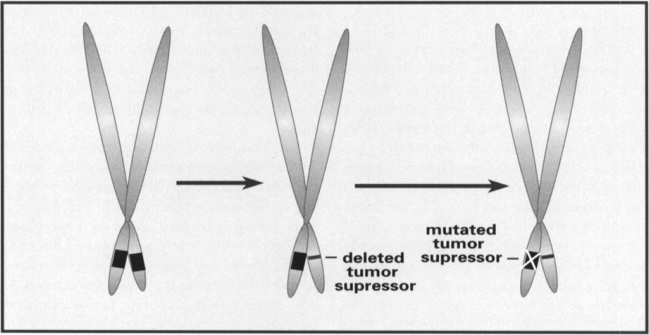
Classification
Cancer genetics groups tumor suppressor genes into three functional classes according to the control that fails upon gene loss. Gatekeepers restrain a potentially malignant cell directly so that damaged cells stop dividing, enter cell-cycle arrest, or undergo apoptosis. Caretakers maintain genome stability and keep the rate of later driver mutations low. Landscapers regulate the tissue microenvironment around a potentially malignant cell.123
The gatekeeper and caretaker distinction entered cancer genetics in 1997, and landscapers joined as a third functional class in 1998.123 Most tumor suppressors follow Alfred Knudson’s classic two-hit pattern, first inferred from retinoblastoma incidence in 1971.4 Because a normal diploid cell carries two alleles of each tumor suppressor, inactivating one allele leaves the intact second allele able to supply functional protein, so growth restraint usually disappears only after a second somatic hit inactivates the remaining allele.45
Gatekeeper genes
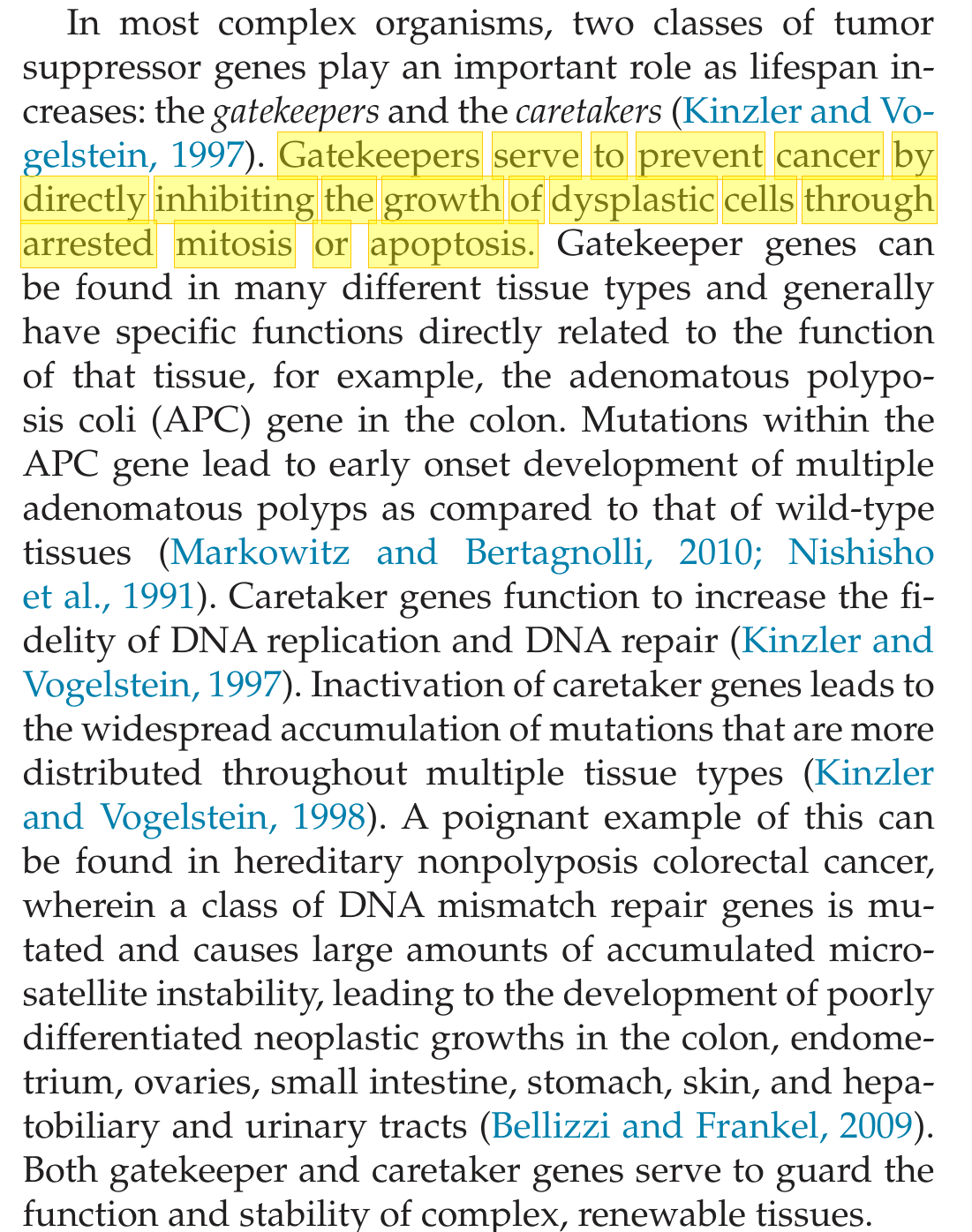
Gatekeeper genes directly restrain abnormal cells from expanding. Once both alleles lose function, the affected cell loses a cell-autonomous brake on proliferation, survives longer than normal, and accumulates additional mutations.6
Classic gatekeepers act at distinct checkpoints in different tissues. In colorectal epithelium, APC acts as an initiation gatekeeper whose loss allows colon crypt cells to grow into adenomas. The retinoblastoma protein RB1 restricts the G1/S cell-cycle transition by inhibiting E2F-dependent transcription, while the transcription factor p53 serves as a broader progression gatekeeper that integrates DNA damage and oncogenic stress to trigger arrest, senescence, or apoptosis. Gatekeeper loss is rate-limiting in renewing tissues that already contain dividing stem and progenitor cells, because the lost gatekeeper previously decided which of those cells could keep dividing.6
Caretaker genes
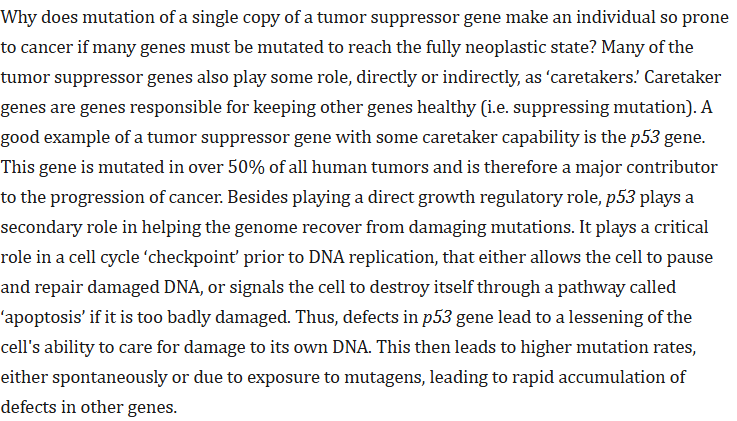
Caretaker genes protect genome integrity and keep the background somatic mutation rate low. Losing a caretaker gene does not immediately force a cell to divide faster. Instead, caretaker loss allows point mutations, deletions, chromosomal rearrangements, and replication errors to build up rapidly so that subsequent hits reach gatekeepers or oncogenes far more quickly.5
DNA mismatch repair genes illustrate this route: defective mismatch repair lets replication errors persist and produces microsatellite instability alongside a sharply elevated mutation supply. BRCA1 and BRCA2 preserve chromosome integrity through homologous recombination repair, while the DNA damage response kinases ATM and ATR coordinate checkpoint arrest and repair programs after DNA breaks. Because every renewing organ depends on DNA replication fidelity and repair, caretaker loss raises cancer risk across multiple tissue types whenever a larger mutation pool accelerates hits on tissue-specific gatekeepers.65
Landscaper genes
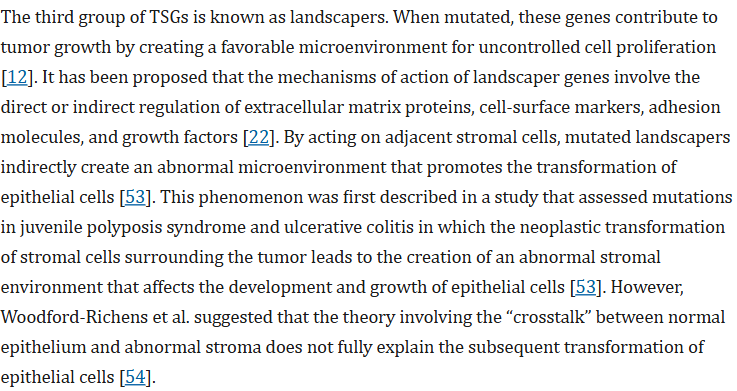
Landscaper genes govern the tissue neighborhood around epithelial cells rather than acting solely inside the future cancer cell itself. When a landscaper gene loses function in stromal or supporting cells, the local microenvironment becomes permissive for neoplastic growth.23 Reviews define landscapers as genes whose loss alters extracellular matrix proteins, cell-surface markers, adhesion molecules, secreted growth factors, and neighboring stromal cells.3
Normal epithelial cells depend on a structured neighborhood of basement membrane, stromal fibroblasts, immune cells, mechanical tension, and adhesion signals. When a landscaper mutation disrupts that neighborhood, surrounding epithelial cells that would otherwise remain restrained gain survival, proliferation, or invasion signals from the altered tissue. A mutation detected inside a tumor can therefore change the epithelial cell directly, alter how the cell signals to the stroma, or remodel the surrounding tissue before malignant epithelial clones even emerge.3
Boundary cases
Real genes often cross boundaries. The protein p53 acts primarily as a gatekeeper that stops damaged or stressed cells from expanding, yet it also exerts caretaker-like effects because p53 signaling coordinates DNA repair and guards genome stability.6 Similarly, NF1 displays both gatekeeper and landscaper behavior depending on tissue context.3 Classification reflects the specific cancer-preventing control that fails in a given organ and stage of progression.
Consequences
Each tumor suppressor class predicts a different primary mechanism of failure and a different experimental readout.
| Class | First prediction | Primary measurement |
|---|---|---|
| Gatekeeper | Direct clonal expansion | Proliferation rate, cell-cycle arrest, apoptosis |
| Caretaker | Higher supply of later mutations | Somatic mutation burden, DNA repair defects |
| Landscaper | Permissive tissue context | Stromal or extracellular-matrix remodeling |
The tumor suppressor theory of aging builds on this same distinction. A gatekeeper-heavy tissue prevents cancer by arresting or killing damaged cells, yet chronic checkpoint activation depletes stem cells and accumulates senescent cells over decades. A caretaker-heavy tissue postpones cancer by keeping mutation supply low without sacrificing cells directly. Meanwhile, an organ whose tissue landscape degrades with age can grow permissive for mutant clones before any single cell acquires every cell-autonomous driver mutation.
References
Footnotes
- Kinzler KW, Vogelstein B. Cancer-susceptibility genes. Gatekeepers and caretakers. Nature. 1997;386(6627):761-763. doi:10.1038/386761a0. PubMed. ↩↩2↩3
- Kinzler KW, Vogelstein B (1998). “Landscaping the cancer terrain”. Science. 280 (5366): 1036–1037. doi:10.1126/science.280.5366.1036↩↩2↩3↩4
- Rajabi S, Alix-Panabières C, Sharbatdar Alaei A, et al. Looking at Thyroid Cancer from the Tumor-Suppressor Genes Point of View. Cancers. 2022;14(10):2461. doi:10.3390/cancers14102461. PMC.↩↩2↩3↩4↩5↩6↩7Review excerpt (Rajabi et al., 2022)
rajabi2022-landscaper-passage.png “When mutated, these genes contribute to tumor growth by creating a favorable microenvironment for uncontrolled cell proliferation… the mechanisms of action of landscaper genes involve the direct or indirect regulation of extracellular matrix proteins, cell-surface markers, adhesion molecules, and growth factors.”
- Knudson AG Jr (1971). “Mutation and cancer: statistical study of retinoblastoma”. Proceedings of the National Academy of Sciences. 68 (4): 820–823. doi:10.1073/pnas.68.4.820↩↩2
- Deininger P. Genetic Instability in Cancer: Caretaker and Gatekeeper Genes. Ochsner Journal. 1999;1(4):206-209. PMC.↩↩2↩3Review excerpt (Deininger, 1999)
deininger1999-caretaker-passage.png “Caretaker genes are genes responsible for keeping other genes healthy (i.e. suppressing mutation).”
- Harris VK, Schiffman JD, Boddy AM. Evolution of Cancer Defense Mechanisms Across Species. 2017.↩↩2↩3↩4Source excerpt (Harris et al., 2017)
valerieharris2017-p5-b6-37a541d7af.png “Gatekeepers serve to prevent cancer by directly inhibiting the growth of dysplastic cells through arrested mitosis or apoptosis.”