W. D. Hamilton
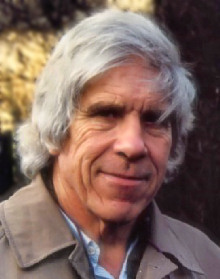
William Donald Hamilton (1936–2000) was a British evolutionary biologist who formulated inclusive fitness theory (kin selection) and Hamilton’s rule.1 He also derived the demographic force of selection governing senescence, pioneered sex-ratio game theory, and co-developed the parasite-driven Red Queen hypothesis.234
Inclusive fitness and Narrow Roads of Gene Land
After academic posts including Imperial College London and a professorship at the University of Oxford, Hamilton collected his major papers in the three-volume Narrow Roads of Gene Land, accompanied by autobiographical introductions to each piece:5
- Volume 1:Evolution of Social Behaviour (1996) — anchored by his 1964 formulation of inclusive fitness and Hamilton’s rule () as the genetic foundation for social behavior and altruism.1
- Volume 2:Evolution of Sex (2001) — centered on sexual reproduction, sex ratios, and host–parasite coevolution.
- Volume 3:Last Words (2005, posthumous) — late theoretical essays and field reflections.
Extraordinary sex ratios
In 1967, Hamilton explained why R. A. Fisher’s classical argument for an equal 1:1 sex ratio fails whenever mating occurs in subdivided patches rather than a panmictic population.3 When brothers compete locally with one another for mates (local mate competition, as in parasitic wasps and fig wasps), selection favors mothers producing heavily female-biased broods—enough sons only to inseminate the sisters in the patch.3 Hamilton also analyzed driving X-linked and Y-linked sex-ratio distorters as intragenomic conflicts, introducing unbeatable-strategy reasoning that directly anticipated John Maynard Smith’s evolutionarily stable strategy (ESS).
Force of selection, parasites, and senescence
Hamilton derived quantitative indicator functions in 1966 showing that the force of selection on age-specific survival and fertility inevitably declines with age after reproductive onset, supplying the mathematical basis for Peter Medawar’s mutation-accumulation model and George C. Williams’s antagonistic pleiotropy.2 He later argued that cycling host–parasite coevolution maintains sexual recombination despite its twofold cost to females.4
Hamilton received the Crafoord Prize and the Kyoto Prize, and died in 2000 from complications of malaria contracted during fieldwork in the Congo.
References
Footnotes
- Hamilton WD. The genetical evolution of social behaviour. Journal of Theoretical Biology. 1964;7(1):1–52. doi:10.1016/0022-5193(64)90038-4 / doi:10.1016/0022-5193(64)90039-6. ↩↩2
- Hamilton WD. The moulding of senescence by natural selection. Journal of Theoretical Biology. 1966;12(1):12–45. doi:10.1016/0022-5193(66)90184-6. ↩↩2
- Hamilton WD. Extraordinary sex ratios. Science. 1967;156(3774):477–488. doi:10.1126/science.156.3774.477. ↩↩2↩3
- Hamilton WD. Sex versus non-sex versus parasite. Oikos. 1980;35:282–290. doi:10.2307/3544435. ↩↩2
- Hamilton WD. Narrow Roads of Gene Land: The Collected Papers of W. D. Hamilton. Vol. 1 (Evolution of Social Behaviour, W. H. Freeman / Spektrum, 1996); Vol. 2 (Evolution of Sex, Oxford University Press, 2001); Vol. 3 (Last Words, Oxford University Press, 2005). ↩