Disposable soma theory
The disposable soma theory is an evolutionary theory of ageing proposed by Thomas Kirkwood in 1977.1 It holds that organisms invest less in maintaining their bodies than indefinite survival would require. Resources spent on somatic repair are unavailable for reproduction, and external hazards discount future reproduction and make an immortal body uneconomical.2 How extrinsic mortality shifts optimal repair investment depends on how population density regulates growth.3 Under this division, the body (soma) is disposable while the germ line must be maintained across generations. Unrepaired somatic damage accumulates over time and causes ageing.24
The theory began as an argument about the accuracy of protein synthesis, proposing that mortality may result from “an energy-saving strategy of reduced error regulation in somatic cells”.1 By 1979, Kirkwood and Robin Holliday extended the argument from protein synthesis to macromolecular synthesis in general, and by 1991 it encompassed somatic maintenance of every kind.25 As the physiological counterpart of antagonistic pleiotropy, the two models converge from physiological ecology and population genetics, and both rely on the declining force of natural selection with age described under selection shadow.5
Three empirical questions have structured subsequent research. First, whether the trade-off between reproduction and longevity reflects limited energy and nutrients, given that mutations and diets in worms and flies can uncouple long life from low fertility.67 Second, whether lifespan extension under dietary restriction represents an evolved shift of resources from reproduction to maintenance.89 Third, whether longer-lived species consistently invest more in cellular maintenance, a prediction supported for some stresses and DNA-repair pathways while absent for others.101112
Terminology
- The soma is all the cells of the body other than the germ line, the cells that give rise to eggs and sperm.
- Somatic maintenance is the set of processes that keep the soma functional: repair of damaged DNA, replacement of damaged proteins and cells, defences against oxidants, wound healing and immunity. The original example was the energy-consuming accuracy of protein synthesis.2
- A trade-off between two traits exists when raising one reduces the other. The cost of reproduction is the trade-off between reproductive effort and later survival or fertility, a relationship described as “of widespread occurrence”.6
- Allocation is the division of resources between competing uses; acquisition is the total amount an individual obtains. Individuals that acquire more resources can reproduce more and live longer at the same time, hiding an underlying allocation trade-off.13
- Extrinsic mortality is the risk of death from external hazards such as predation or accidents that kill individuals regardless of internal condition.
Kirkwood’s argument
From error catastrophe to maintenance
The error catastrophe hypothesis, introduced by Leslie Orgel in 1963, proposed that errors in protein synthesis could amplify themselves: a mistake in a translational enzyme produces further mistakes until the cell collapses.14 Kirkwood argued in 1977 that preventing such a cascade requires metabolic energy for proofreading, which an organism can save inside somatic cells. His paper concluded that mortality may be “due to an energy-saving strategy of reduced error regulation in somatic cells” in support of Orgel’s hypothesis.1 Direct measurements later contradicted the error-catastrophe mechanism because protein error frequencies in cultured human fibroblasts did not rise with passage or donor age, and an immortal transformed line produced higher error rates than mortal cells.15 The disposable soma argument persisted because its evolutionary logic applies to somatic damage of any form.
In 1979, Kirkwood and Holliday broadened the framework to macromolecular accuracy in general. Maintaining macromolecules accurately enough “to prevent error feedback and the development of lethal ‘error catastrophes’” demands energy; adopting “an energy saving strategy of reduced accuracy in somatic cells to accelerate development and reproduction” can raise fitness even though eventual deterioration and death follow.2 The germ line must preserve high accuracy, or cull defective germ cells, for a lineage to endure. On that basis they rejected adaptive programmed ageing: “Ageing is not adaptive since it reduces reproductive potential.”2
Optimal allocation
At its formal core, the theory poses an optimization problem. An individual divides finite resources between reproduction and somatic maintenance. Higher maintenance yields fewer offspring per year while slowing the rise in mortality with age, and natural selection favors the split that maximizes fitness. Because external hazards kill individuals before infinite ages, formal modeling confirmed that “the optimum investment in somatic maintenance is less than what would be required for indefinite longevity”.16
Figure 1 is an illustrative version of the model. With an external mortality rate of 0.1 a year, the best strategy spends 22% of its resources on maintenance, and its members would live a median of 18 years if nothing external killed them. Drag the risk down to 0.02 a year: in a population held constant by fewer births, the best share rises to 48% and the median lifespan to 39 years. At 0.3 a year, maintenance is not worth paying for at all. In a population free to grow or shrink, the best share does not change.
{
"$schema": "https://vega.github.io/schema/vega-lite/v6.json",
"description": "Figure 1. An illustrative disposable-soma model. An animal divides its resources between reproduction and maintenance; the more it spends on maintenance, the fewer offspring it has each year and the more slowly its mortality rate rises with age. The slider sets the external mortality rate. The first panel shows the share of resources spent on maintenance that maximises fitness, when the population is held constant by fewer births (solid line) and when it is free to grow or shrink (dashed line). The second shows, for the best strategy, the share still alive at each age if there were no external deaths, which measures how fast it ages. The model's numbers are arbitrary; only the directions of change carry over to real organisms.",
"params": [
{
"name": "H",
"value": 0.1,
"bind": {
"input": "range",
"min": 0,
"max": 0.5,
"step": 0.005,
"name": "External mortality rate, per year"
}
}
],
"hconcat": [
{
"width": 290,
"height": 230,
"layer": [
{
"data": {
"url": "/attachments/disposable-soma-model.csv"
},
"mark": {
"type": "line",
"style": "alt",
"clip": true
},
"encoding": {
"x": {
"field": "h",
"type": "quantitative"
},
"y": {
"field": "growth",
"type": "quantitative"
}
}
},
{
"data": {
"url": "/attachments/disposable-soma-model.csv"
},
"mark": {
"type": "line",
"style": "model",
"clip": true
},
"encoding": {
"x": {
"field": "h",
"type": "quantitative"
},
"y": {
"field": "births",
"type": "quantitative"
}
}
},
{
"data": {
"values": [
{}
]
},
"mark": {
"type": "rule",
"style": "guide"
},
"encoding": {
"x": {
"datum": {
"expr": "H"
},
"type": "quantitative"
}
}
},
{
"data": {
"url": "/attachments/disposable-soma-model.csv"
},
"transform": [
{
"filter": "abs(datum.h - H) < 0.001"
}
],
"layer": [
{
"mark": {
"type": "circle",
"style": "model-point",
"size": 60
},
"encoding": {
"y": {
"field": "births",
"type": "quantitative"
}
}
},
{
"mark": {
"type": "circle",
"style": "alt",
"opacity": 1,
"size": 60
},
"encoding": {
"y": {
"field": "growth",
"type": "quantitative"
}
}
}
],
"encoding": {
"x": {
"field": "h",
"type": "quantitative"
}
}
},
{
"data": {
"values": [
{
"h": 0.2,
"h2": 0.24,
"y": 0.66,
"label": "Held constant by fewer births",
"kind": "model"
},
{
"h": 0.2,
"h2": 0.24,
"y": 0.6,
"label": "Free to grow or shrink",
"kind": "alt"
}
]
},
"layer": [
{
"transform": [
{
"filter": "datum.kind == 'model'"
}
],
"mark": {
"type": "rule",
"style": "model"
},
"encoding": {
"x2": {
"field": "h2"
}
}
},
{
"transform": [
{
"filter": "datum.kind == 'alt'"
}
],
"mark": {
"type": "rule",
"style": "alt"
},
"encoding": {
"x2": {
"field": "h2"
}
}
},
{
"transform": [
{
"filter": "datum.kind == 'model'"
}
],
"mark": {
"type": "text",
"style": "model-label",
"align": "left",
"dx": 6
},
"encoding": {
"x": {
"field": "h2",
"type": "quantitative"
},
"text": {
"field": "label"
}
}
},
{
"transform": [
{
"filter": "datum.kind == 'alt'"
}
],
"mark": {
"type": "text",
"style": "alt-label",
"align": "left",
"dx": 6
},
"encoding": {
"x": {
"field": "h2",
"type": "quantitative"
},
"text": {
"field": "label"
}
}
}
],
"encoding": {
"x": {
"field": "h",
"type": "quantitative"
},
"y": {
"field": "y",
"type": "quantitative"
}
}
}
],
"encoding": {
"x": {
"type": "quantitative",
"scale": {
"domain": [
0,
0.5
],
"nice": false
},
"axis": {
"title": "External mortality rate, per year",
"values": [
0,
0.1,
0.2,
0.3,
0.4,
0.5
]
}
},
"y": {
"type": "quantitative",
"scale": {
"domain": [
0,
0.7
],
"nice": false
},
"axis": {
"title": "Best share spent on maintenance",
"format": ".0%",
"values": [
0,
0.2,
0.4,
0.6
]
}
}
}
},
{
"width": 290,
"height": 230,
"layer": [
{
"data": {
"url": "/attachments/disposable-soma-model.csv"
},
"transform": [
{
"filter": "abs(datum.h - H) < 0.001"
},
{
"fold": [
"births",
"growth"
],
"as": [
"mode",
"rho"
]
},
{
"calculate": "0.6 * exp(-4 * datum.rho)",
"as": "b"
},
{
"calculate": "sequence(0, 121, 1)",
"as": "age"
},
{
"flatten": [
"age"
]
},
{
"calculate": "exp(-(0.002 / datum.b) * (exp(datum.b * datum.age) - 1))",
"as": "alive"
}
],
"layer": [
{
"transform": [
{
"filter": "datum.mode == 'growth'"
}
],
"mark": {
"type": "line",
"style": "alt"
}
},
{
"transform": [
{
"filter": "datum.mode == 'births'"
}
],
"mark": {
"type": "line",
"style": "model"
}
}
],
"encoding": {
"x": {
"field": "age",
"type": "quantitative"
},
"y": {
"field": "alive",
"type": "quantitative"
}
}
},
{
"data": {
"url": "/attachments/disposable-soma-model.csv"
},
"transform": [
{
"filter": "abs(datum.h - H) < 0.001"
},
{
"fold": [
"births",
"growth"
],
"as": [
"mode",
"rho"
]
},
{
"calculate": "0.6 * exp(-4 * datum.rho)",
"as": "b"
},
{
"calculate": "log(1 + log(2) * datum.b / 0.002) / datum.b",
"as": "median"
},
{
"calculate": "(datum.mode == 'births' ? 'Fewer births: ' : 'Free growth: ') + format(datum.median, '.0f') + ' years'",
"as": "label"
},
{
"calculate": "118",
"as": "lx"
},
{
"calculate": "datum.mode == 'births' ? 1.0 : 0.91",
"as": "ly"
}
],
"layer": [
{
"transform": [
{
"filter": "datum.mode == 'births'"
}
],
"mark": {
"type": "text",
"style": "model-label",
"align": "right",
"baseline": "top"
}
},
{
"transform": [
{
"filter": "datum.mode == 'growth'"
}
],
"mark": {
"type": "text",
"style": "alt-label",
"align": "right",
"baseline": "top"
}
}
],
"encoding": {
"x": {
"field": "lx",
"type": "quantitative"
},
"y": {
"field": "ly",
"type": "quantitative"
},
"text": {
"field": "label"
}
}
},
{
"data": {
"values": [
{
"x": 118,
"y": 0.82,
"label": "median lifespan, no external deaths"
}
]
},
"mark": {
"type": "text",
"style": "observed-label",
"align": "right",
"baseline": "top"
},
"encoding": {
"x": {
"field": "x",
"type": "quantitative"
},
"y": {
"field": "y",
"type": "quantitative"
},
"text": {
"field": "label"
}
}
}
],
"encoding": {
"x": {
"type": "quantitative",
"scale": {
"domain": [
0,
120
],
"nice": false
},
"axis": {
"title": "Age",
"values": [
0,
20,
40,
60,
80,
100,
120
]
}
},
"y": {
"type": "quantitative",
"scale": {
"domain": [
0,
1.02
],
"nice": false
},
"axis": {
"title": "Alive without external deaths",
"format": ".0%",
"values": [
0,
0.25,
0.5,
0.75,
1
]
}
}
}
}
]
}Which curve applies depends on how population density regulates growth. Life-history optimization shows that natural selection maximizes lifetime reproductive output when high population density lowers birth rates or juvenile survival. By contrast, selection maximizes population growth rate when density raises mortality equally across all ages or when populations grow freely.17 Higher external mortality reduces optimal somatic maintenance only in the first case. This mirrors the broader demographic result that extrinsic mortality can accelerate ageing, slow it, or leave it unchanged depending on how density dependence acts (see Selection shadow).18
A share of resources goes to maintenance. From maturity at age 1, an individual has offspring a year. Its mortality rate from internal causes follows the Gompertz law (see Mortality rate models),
so that more maintenance slows the rise in mortality with age. External causes add a constant risk . With the share surviving internal causes to age , lifetime reproduction and the growth rate are
In the second equation appears only in the sum , so the share that maximises does not depend on . The figure uses , and , with set so that the best strategy neither grows nor shrinks at . The two optima then coincide at .
Later models
Age-structured optimization models extended Kirkwood’s static trade-off across the full life course. Dynamic models of optimal age-specific allocation between reproduction and repair predict that mortality “should increase at an increasing rate with age”, yet an exponential Gompertz trajectory represents only one special case among many possible trade-off shapes.19 Adding somatic growth to the allocation problem showed that low extrinsic mortality and efficient repair favor early repair investment alongside slow growth, late maturity, large adult body size, and long lifespan, suggesting that observed life-history syndromes can emerge as “by-products of optimal allocation strategies”.20
Evidence
Costs of reproduction
The disposable soma framework predicts that heavy reproductive effort shortens lifespan or lowers later fertility. Experimental measurements in female Drosophila found that egg production causes a delayed wave of excess mortality that coincides with the onset of steep age-related mortality and its subsequent deceleration.21 In free-ranging vertebrates, a compilation of 26 field studies found “overall support for the presence of early-late life trade-offs” in 21 populations, although antagonistic pleiotropy predicts the same pattern and the two theories remain difficult to separate in wild data.22
Direct physiological measurements of reproductive cost have proved harder to pin down. In small mammals, reproductive effort raises “energy, protein and calcium demands during pregnancy, but most particularly during lactation”, yet physiological understanding of how those demands cause lasting somatic wear remains “at best described as rudimentary”.23 Oxidative damage from heightened reproductive metabolism has received mixed experimental support because outcomes vary sharply across tissues and assays.24 Across captive zoo populations of 18 mammal and 12 bird species where food is abundant, only one of 68 regressions between reproductive output and subsequent lifespan reached statistical significance, and its slope was positive.25 Historical castration records are equally ambiguous. In one genealogy, 81 Korean court eunuchs of the Chosŏn dynasty lived to a mean age of 70 (14 to 19 years longer than intact peers, though three reported centenarians suggest age-recording errors), whereas Italian castrati lived no longer than intact singers, and castration alters testosterone alongside fertility.2627
Historical human genealogies have likewise yielded weak or inconsistent evidence for a strong cost of reproduction. An influential 1998 analysis of British aristocrats reported that the longest-lived women had fewer children and higher rates of childlessness.28 Cross-checking 335 allegedly childless aristocratic women against independent genealogical records later showed that “at least 107 allegedly childless women did have children” (32%), including a woman recorded with one child who had twelve. Across 3,723 verified European noblewomen, childlessness stayed at 10–17% at every age at death and exceptional longevity showed no excess infertility.29 Adjusting for health heterogeneity in the British peerage revealed a small reproduction–longevity trade-off in peeresses and none in peers.30 Pre-industrial Finnish Sami data showed each son reducing maternal lifespan by about 0.65 years and each daughter adding about 0.44 years.3132 Swedish cohorts including 930 northern Sami women showed no such relationship,3332 and a later Finnish analysis found reduced post-reproductive survival only in mothers of many sons.34 Reviews of natural-fertility populations find no consistent decline in longevity with higher parity. In modern cohorts, childless adults experience higher mortality than parents because underlying health shapes both fertility and survival.3536
Lifespan and reproduction uncoupled
If ageing followed directly from somatic energy diverted into reproduction, removing reproduction should lengthen life and extending life should reduce fertility. Several experimental manipulations in model organisms break that symmetry. In Caenorhabditis elegans, ablating germ-line precursor cells extends lifespan while removing the entire gonad leaves lifespan unchanged, an effect dependent on the DAF-16 and DAF-12 transcription factors.37 Proliferating germ-line stem cells regulate this endocrine longevity signal directly, whereas “neither sperm, nor oocytes, nor meiotic precursor cells are responsible”.38 In Drosophila, germ-line ablation has produced opposing outcomes across studies: it shortened female lifespan in one experiment and extended it with altered insulin signaling in another.3940
Temporal knockdown experiments in C. elegans similarly showed that adult insulin/IGF-1 signaling “controls longevity and reproduction independently of one another”.41 In Drosophila, dietary restriction extends lifespan and lowers egg laying. Supplementing restricted food with the single amino acid methionine “increased fecundity as much as full feeding, but without reducing lifespan”, and investigators concluded that “reallocation of nutrients therefore does not explain the DR responses”.9 Adding all essential amino acids restored fecundity and shortened life. Across insulin/IGF mutations and dietary restriction in model organisms, researchers concluded that both interventions can extend lifespan without invariably reducing fecundity.6
Dietary restriction
An influential evolutionary extension proposed that dietary restriction triggers an adaptive famine response that shifts energy from reproduction toward somatic maintenance until food returns.8 Formal life-history modeling showed that such reallocation pays off only when juveniles survive poorly during famine or when reproduction requires a fixed energetic overhead before producing any offspring. As the authors noted, “if neither of these conditions holds, there is no evolutionary advantage to be gained from switching extra resources to maintenance”.8
Subsequent experimental work in Drosophila challenged the resource-reallocation hypothesis on multiple fronts. Aside from methionine rescuing fecundity without shortening life,9 alternative models interpret dietary-restriction responses as nutrient-recycling programs that maximize immediate reproductive readiness during food scarcity, with extended laboratory survival arising as a byproduct.42 Other researchers treat these signaling pathways as broad integrators of multiple environmental cues beyond calories.43 Experiments in female Drosophila demonstrated that protein-rich diets shorten lifespan by depleting dietary sterols through heavy egg production. Adding cholesterol restored full lifespan, so female flies on protein-rich, sterol-supplemented diets were both longest-lived and most fecund.44 Whether a similar limiting-nutrient trade-off operates in mammals remains untested.
Maintenance across species
The disposable soma framework also predicts stronger cellular repair and stress resistance in longer-lived species. Across skin fibroblasts from eight mammal species, resistance to oxidants, arsenite, and alkali yielded “significant positive correlations between cell LD90 and maximum life span” for every agent tested.10 Tests on fibroblasts from wild-caught rodents and a bat confirmed higher resistance to cadmium, hydrogen peroxide, and heat in longer-lived species. Paraquat, ultraviolet light, and an alkylating agent showed no consistent association.11
Comparative DNA-repair studies reveal a similar pathway-specific split. Early assays across seven mammal species reported that ultraviolet excision repair rose with lifespan,45 whereas a 34-species survey found no correlation.46 Across 18 rodent species, DNA double-strand break repair scaled strongly with maximum lifespan while ultraviolet nucleotide-excision repair did not. Much of the species difference in double-strand break repair mapped to amino-acid divergence in the repair enzyme SIRT6.12 Comparisons among species facing different external mortality regimes, such as bats and terrestrial mammals of equal body mass, are examined under Selection shadow.
Alternatives
Because experimental studies in worms and flies have repeatedly separated longevity from reproductive output, several evolutionary biologists argue that energy allocation trade-offs explain only part of ageing.7 In this view, molecular pathways optimized for rapid early development and reproduction continue running at suboptimally high levels in adulthood because late-life natural selection is weak. Those overactive adult programs cause physiological harm directly rather than through unmet repair budgets.7
The hyperfunction theory formalizes this developmental-continuation alternative. Proponents argue that “molecular damage does not cause that aging that kills us” and that continued biosynthetic activity driven by nutrient-sensing pathways such as TOR after growth finishes generates age-related pathology.47 Studies in C. elegans where oxidative-damage tests failed to alter lifespan while overactive reproductive and developmental biosynthesis produced tissue pathology support hyperfunction as a competing mechanism in some organisms.4849
A third mechanism involves maintenance defenses that themselves drive tissue decline. Tumor-suppressive barriers such as telomere shortening and cellular senescence protect aging organisms against cancer while gradually impairing tissue renewal and homeostasis (see Antagonistic pleiotropy and Tumor Suppressor Theory of Aging).50
Relationship to other theories
Disposable soma theory connects directly to the major evolutionary and demographic frameworks of ageing. Within evolutionary genetics, it supplies a physiological mechanism for antagonistic pleiotropy: an allele that shifts resources from somatic repair toward early reproduction boosts early fitness at the cost of later survival.5 By contrast, mutation accumulation operates independently of resource trade-offs, though both rely on the declining force of natural selection with age. In demographic modeling, optimal allocation theories generally predict an accelerating rise in adult mortality with age. They match the exponential Gompertz trajectory only under specific assumptions about how repair affects hazard rates (see Mortality rate models).19
History
Kirkwood introduced the disposable soma theory in Nature in 1977 to explain why somatic cells might tolerate translational error rates forbidden in the germ line.1 His 1979 paper with Holliday generalized the argument to overall macromolecular accuracy,2 and a 1991 synthesis with Michael Rose aligned disposable soma theory with antagonistic pleiotropy as convergent explanations of senescence.5
During the 1990s and 2000, explicit mathematical models formalized age-specific allocation among growth, reproduction, and repair,1920 comparative fibroblast assays tested interspecific stress resistance,10 historical peerage analyses searched for human reproductive costs,28 and life-history models extended the framework to dietary restriction.8 Beginning in 1999, experimental uncoupling of lifespan and fertility in C. elegans and Drosophila—through germ-line endocrine signaling,3738 adult insulin/IGF-1 timing,41 and dietary amino-acid or sterol supplementation944—prompted competing developmental-continuation and hyperfunction models of ageing.47749
Data and figures
Figure 1 is computed from the model in the note beside it and uses no empirical data. The optimal share of resources spent on maintenance was computed across a grid of shares spaced 0.005 apart for external mortality risks ranging from 0 to 0.5 per year in steps of 0.005. The median lifespan without external deaths is the age where .
References
Footnotes
- Kirkwood TBL (1977). “Evolution of ageing”. Nature. 270 (5635): 301–304. doi:10.1038/270301a0↩↩2↩3↩4Primary source excerpt (Kirkwood, 1977 — p. 301)
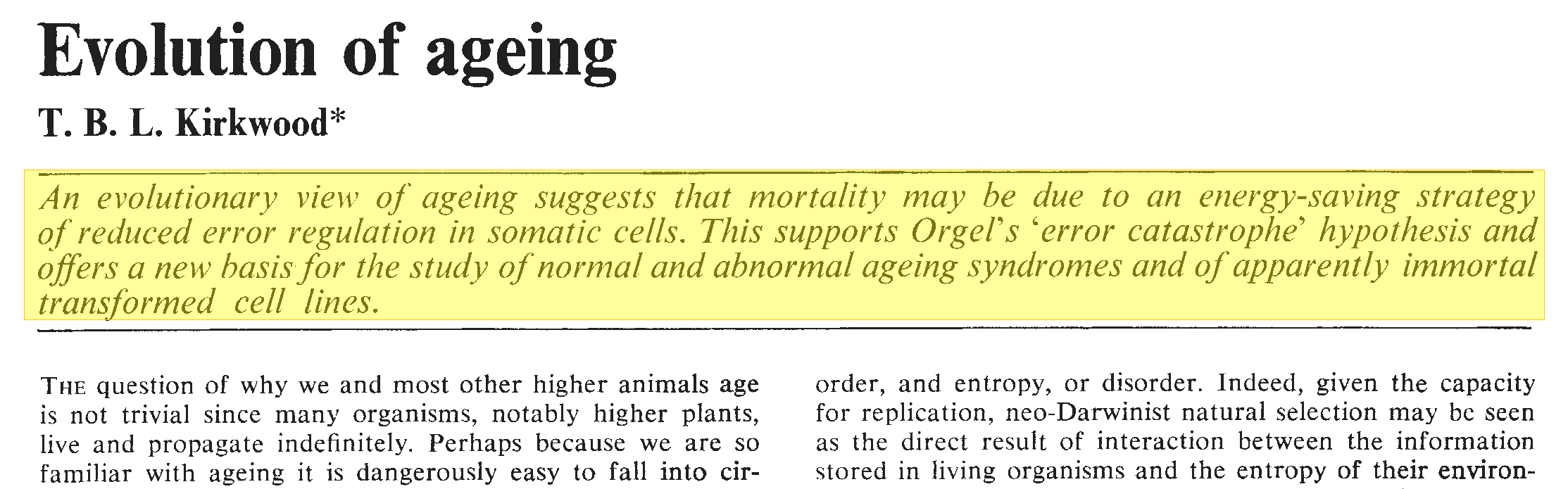
thomasb.l.kirkwood1977-p1-b3-37733a6e60.png “An evolutionary view of ageing suggests that mortality may be due to an energy-saving strategy of reduced error regulation in somatic cells. This supports Orgel’s ‘error catastrophe’ hypothesis…”
- Kirkwood TBL, Holliday R (1979). “The evolution of ageing and longevity”. Proceedings of the Royal Society B. 205 (1161): 531–546. doi:10.1098/rspb.1979.0083↩↩2↩3↩4↩5↩6↩7
- Moorad J, Promislow D, Silvertown J (2019). “Evolutionary ecology of senescence and a reassessment of Williams’ ‘extrinsic mortality’ hypothesis”. Trends in Ecology & Evolution. 34 (6): 519–530. doi:10.1016/j.tree.2019.02.006↩
- Kirkwood TBL (2005). “Understanding the odd science of aging”. Cell. 120 (4): 437–447. doi:10.1016/j.cell.2005.01.027↩
- Kirkwood TBL, Rose MR (1991). “Evolution of senescence: late survival sacrificed for reproduction”. Philosophical Transactions of the Royal Society B. 332: 15–24. doi:10.1098/rstb.1991.0028↩↩2↩3↩4
- Partridge L, Gems D, Withers DJ (2005). “Sex and death: what is the connection?”. Cell. 120 (4): 461–472. doi:10.1016/j.cell.2005.01.026↩↩2↩3
- Maklakov AA, Chapman T (2019). “Evolution of ageing as a tangle of trade-offs: energy versus function”. Proceedings of the Royal Society B. 286 (1911): 20191604. doi:10.1098/rspb.2019.1604↩↩2↩3↩4
- Shanley DP, Kirkwood TBL (2000). “Calorie restriction and aging: a life-history analysis”. Evolution. 54 (3): 740–750. doi:10.1111/j.0014-3820.2000.tb00076.x↩↩2↩3↩4
- Grandison RC, Piper MDW, Partridge L (2009). “Amino-acid imbalance explains extension of lifespan by dietary restriction in Drosophila”. Nature. 462: 1061–1064. doi:10.1038/nature08619↩↩2↩3↩4
- Kapahi P, Boulton ME, Kirkwood TBL (1999). “Positive correlation between mammalian life span and cellular resistance to stress”. Free Radical Biology and Medicine. 26 (5–6): 495–500. doi:10.1016/S0891-5849(98)00323-2↩↩2↩3
- Harper JM, Salmon AB, Leiser SF, Galecki AT, Miller RA (2007). “Skin-derived fibroblasts from long-lived species are resistant to some, but not all, lethal stresses and to the mitochondrial inhibitor rotenone”. Aging Cell. 6 (1): 1–13. doi:10.1111/j.1474-9726.2006.00255.x↩↩2
- Tian X, Firsanov D, Zhang Z, et al. (2019). “SIRT6 is responsible for more efficient DNA double-strand break repair in long-lived species”. Cell. 177 (3): 622–638. doi:10.1016/j.cell.2019.03.043↩↩2
- van Noordwijk AJ, de Jong G (1986). “Acquisition and allocation of resources: their influence on variation in life history tactics”. The American Naturalist. 128 (1): 137–142. doi:10.1086/284547↩
- Orgel LE (1963). “The maintenance of the accuracy of protein synthesis and its relevance to ageing”. PNAS. 49 (4): 517–521. doi:10.1073/pnas.49.4.517↩
- Harley CB, Pollard JW, Chamberlain JW, Stanners CP, Goldstein S (1980). “Protein synthetic errors do not increase during aging of cultured human fibroblasts”. PNAS. 77 (4): 1885–1889. doi:10.1073/pnas.77.4.1885↩
- Drenos F, Kirkwood TBL (2005). “Modelling the disposable soma theory of ageing”. Mechanisms of Ageing and Development. 126 (1): 99–103. doi:10.1016/j.mad.2004.09.026↩
- Mylius SD, Diekmann O (1995). “On evolutionarily stable life histories, optimization and the need to be specific about density dependence”. Oikos. 74 (2): 218–224. doi:10.2307/3545651↩
- Abrams PA (1993). “Does increased mortality favor the evolution of more rapid senescence?”. Evolution. 47 (3): 877–887. doi:10.2307/2410191↩
- Abrams PA, Ludwig D (1995). “Optimality theory, Gompertz’ law, and the disposable soma theory of senescence”. Evolution. 49 (6): 1055–1066. doi:10.1111/j.1558-5646.1995.tb04433.x↩↩2↩3
- Cichoń M (1997). “Evolution of longevity through optimal resource allocation”. Proceedings of the Royal Society B. 264 (1386): 1383–1388. doi:10.1098/rspb.1997.0192↩↩2
- Sgrò CM, Partridge L (1999). “A delayed wave of death from reproduction in Drosophila”. Science. 286 (5449): 2521–2524. doi:10.1126/science.286.5449.2521↩
- Lemaître J-F, Berger V, Bonenfant C, Douhard M, Gamelon M, et al. (2015). “Early-late life trade-offs and the evolution of ageing in the wild”. Proceedings of the Royal Society B. 282 (1806): 20150209. doi:10.1098/rspb.2015.0209↩
- Speakman JR (2008). “The physiological costs of reproduction in small mammals”. Philosophical Transactions of the Royal Society B. 363 (1490): 375–398. doi:10.1098/rstb.2007.2145↩
- Speakman JR, Garratt M (2014). “Oxidative stress as a cost of reproduction: beyond the simplistic trade-off model”. BioEssays. 36 (1): 93–106. doi:10.1002/bies.201300108↩
- Ricklefs RE, Cadena CD (2007). “Lifespan is unrelated to investment in reproduction in populations of mammals and birds in captivity”. Ecology Letters. 10 (10): 867–872. doi:10.1111/j.1461-0248.2007.01085.x↩
- Min K-J, Lee C-K, Park H-N (2012). “The lifespan of Korean eunuchs”. Current Biology. 22 (18): R792–R793. doi:10.1016/j.cub.2012.06.036↩
- Nieschlag E, Nieschlag S, Behre HM (1993). “Lifespan and testosterone”. Nature. 366 (6452): 215. doi:10.1038/366215a0↩
- Westendorp RGJ, Kirkwood TBL (1998). “Human longevity at the cost of reproductive success”. Nature. 396: 743–746. doi:10.1038/25519↩↩2
- Gavrilova NS, Gavrilov LA, Semyonova VG, Evdokushkina GN (2004). “Does exceptional human longevity come with a high cost of infertility? Testing the evolutionary theories of aging”. Annals of the New York Academy of Sciences. 1019: 513–517. doi:10.1196/annals.1297.095↩
- Doblhammer G, Oeppen J (2003). “Reproduction and longevity among the British peerage: the effect of frailty and health selection”. Proceedings of the Royal Society B. 270 (1524): 1541–1547. doi:10.1098/rspb.2003.2400↩
- Helle S, Lummaa V, Jokela J (2002). “Sons reduced maternal longevity in preindustrial humans”. Science. 296 (5570): 1085. doi:10.1126/science.1070106↩
- Cesarini D, Lindqvist E, Wallace B (2009). “Is there an adverse effect of sons on maternal longevity?”. Proceedings of the Royal Society B. 276 (1664): 2081–2084. doi:10.1098/rspb.2009.0051↩↩2
- Cesarini D, Lindqvist E, Wallace B (2007). “Maternal longevity and the sex of offspring in pre-industrial Sweden”. Annals of Human Biology. 34 (5): 535–546. doi:10.1080/03014460701517215↩
- Helle S, Lummaa V (2013). “A trade-off between having many sons and shorter maternal post-reproductive survival in pre-industrial Finland”. Biology Letters. 9 (2): 20130034. doi:10.1098/rsbl.2013.0034↩
- Le Bourg É (2007). “Does reproduction decrease longevity in human beings?”. Ageing Research Reviews. 6 (2): 141–149. doi:10.1016/j.arr.2007.04.002↩
- Zeng Y, Ni Z-M, Liu S-Y, Gu X, Huang Q, et al. (2016). “Parity and all-cause mortality in women and men: a dose-response meta-analysis of cohort studies”. Scientific Reports. 6: 19351. doi:10.1038/srep19351↩
- Hsin H, Kenyon C (1999). “Signals from the reproductive system regulate the lifespan of C. elegans”. Nature. 399: 362–366. doi:10.1038/20694↩↩2
- Arantes-Oliveira N, Apfeld J, Dillin A, Kenyon C (2002). “Regulation of life-span by germ-line stem cells in Caenorhabditis elegans”. Science. 295 (5554): 502–505. doi:10.1126/science.1065768↩↩2
- Barnes AI, Boone JM, Jacobson J, Partridge L, Chapman T (2006). “No extension of lifespan by ablation of germ line in Drosophila”. Proceedings of the Royal Society B. 273 (1589): 939–947. doi:10.1098/rspb.2005.3388↩
- Flatt T, Min K-J, D’Alterio C, Villa-Cuesta E, Cumbers J, et al. (2008). “Drosophila germ-line modulation of insulin signaling and lifespan”. PNAS. 105 (17): 6368–6373. doi:10.1073/pnas.0709128105↩
- Dillin A, Crawford DK, Kenyon C (2002). “Timing requirements for insulin/IGF-1 signaling in C. elegans”. Science. 298 (5594): 830–834. doi:10.1126/science.1074240↩↩2
- Adler MI, Bonduriansky R (2014). “Why do the well-fed appear to die young? A new evolutionary hypothesis for the effect of dietary restriction on lifespan”. BioEssays. 36 (5): 439–450. doi:10.1002/bies.201300165↩
- Regan JC, Froy H, Walling CA, Moatt JP, Nussey DH (2020). “Dietary restriction and insulin-like signalling pathways as adaptive plasticity: a synthesis and re-evaluation”. Functional Ecology. 34 (1): 107–128. doi:10.1111/1365-2435.13418↩
- Zanco B, Mirth CK, Sgrò CM, Piper MDW (2021). “A dietary sterol trade-off determines lifespan responses to dietary restriction in Drosophila melanogaster females”. eLife. 10: e62335. doi:10.7554/eLife.62335↩↩2
- Hart RW, Setlow RB (1974). “Correlation between deoxyribonucleic acid excision-repair and life-span in a number of mammalian species”. PNAS. 71 (6): 2169–2173. doi:10.1073/pnas.71.6.2169↩
- Kato H, Harada M, Tsuchiya K, Moriwaki K (1980). “Absence of correlation between DNA repair in ultraviolet irradiated mammalian cells and life span of the donor species”. Japanese Journal of Genetics. 55 (2): 99–108. doi:10.1266/jjg.55.99↩
- Blagosklonny MV (2010). “Why the disposable soma theory cannot explain why women live longer and why we age”. Aging. 2 (12): 884–887. doi:10.18632/aging.100253↩↩2
- Gems D, de la Guardia Y (2013). “Alternative perspectives on aging in Caenorhabditis elegans: reactive oxygen species or hyperfunction?”. Antioxidants & Redox Signaling. 19 (3): 321–329. doi:10.1089/ars.2012.4840↩
- Gems D (2022). “The hyperfunction theory: an emerging paradigm for the biology of aging”. Ageing Research Reviews. 74: 101557. doi:10.1016/j.arr.2021.101557↩↩2
- Campisi J (2005). “Senescent cells, tumor suppression, and organismal aging: good citizens, bad neighbors”. Cell. 120 (4): 513–522. doi:10.1016/j.cell.2005.02.003↩