Longevity winter
Longevity winter is the roughly forty-year period since the mid-1980s with no new maximum-lifespan record in laboratory rodents. Drugs and genetic manipulations have repeatedly extended median lifespan and improved late-life health in mice and rats. Yet no published survival curve has beaten the rodent maximum-lifespan records set under severe caloric restriction in 1961 and 1986–1987.1
Those unbroken records highlight the difference between median lifespan and the upper tail of a survival curve. Median lifespan rises whenever mortality drops during early or middle adulthood. Maximum lifespan moves only when mortality falls among the oldest surviving members of a cohort. In demographic models, twentieth-century gains in human life expectancy came primarily from lower infant, childhood, and young-adult mortality, while the exponential slope of adult mortality remained nearly invariant across human and primate populations.2
Mammalian maximum-lifespan records
In 2026, a Nature Aging review of dietary restriction co-authored by Richard Weindruch (who reported the female mouse record forty years earlier) noted that no published survival curve has exceeded three caloric-restriction benchmarks. Those benchmarks are a 1,742-day male mouse,3 a 1,660-day female mouse,4 and a 1,638-day rat.51 Among non-human primates, the longest-lived rhesus monkey in the National Institute on Aging caloric-restriction cohort reached 44.2 years. In humans, the longest verified lifespan remains Jeanne Calment at 122 years and 164 days, recorded in 1997.16
Two details in the 1987 male mouse paper qualify how cleanly that 1,742-day record represents continuous caloric restriction. First, the longest-lived B6CBAF1 male was returned to ad libitum feeding from day 1,541 until its death at day 1,742.3 Second, the same two-thirds food-restriction regimen shortened mean lifespan in inbred C57BL/6J (B6-+/+) males from 858 days to 593 days inside the same laboratory; severe restriction can extend life in a vigorous F1 hybrid while it harms an inbred strain.3 Between the two mouse studies, the female C3B10RF1 cohort offers a sturdier tail measurement: its longest-lived decile averaged 53.0 months (about 1,611 days), so the entire upper tenth of the cohort shifted outward rather than a single outlier.41
| Species | Strain or cohort | Regimen | Published maximum | Source |
|---|---|---|---|---|
| Male mouse | B6CBAF1 () | Two-thirds of ad libitum intake (longest-lived mouse fed ad libitum from day 1,541 to 1,742) | 1,742 days (top decile 1,432–1,742 days) | 3 |
| Female mouse | C3B10RF1 | About 65% restriction on alternating-day feeding (Mon/Wed/double Fri) | 1,660 days (top-decile mean 53.0 months, ~1,611 days) | 4 |
| Rat | Sprague–Dawley | About 80% CR (16 vs. 83 kcal/day) | 1,638 days | 5 |
| Rhesus monkey | NIA caloric-restriction cohort | 30% CR | 44.2 years (species record) | 1 |
| Human | Verified supercentenarian (Jeanne Calment) | Unintervened | 122 years, 164 days (d. 1997) | 6 |
Biological ceiling or experimental scarcity
Two interpretations of the unbroken rodent records remain open. Mammalian biology may impose a practical upper boundary on mouse lifespan near 1,750 days under viable metabolic conditions. Alternatively, modern laboratories rarely run experiments built to surpass the 1980s records. Five-year survival trials in long-lived F1 hybrids are costly, current animal-welfare rules require earlier humane endpoints than in the 1960s and 1980s, and severe 65% caloric restriction is seldom paired with newer drugs in full lifespan studies.
A similar ambiguity appears in human demography. Analyses of international supercentenarian data have argued that maximum reported age at death plateaued after the late 1990s below Jeanne Calment’s 122.4 years.6 However, because very few people live past 110, demographic series at extreme ages have low statistical power to separate a strict biological ceiling from a steeply rising mortality curve with no hard cutoff. (For how these lifespan boundaries constrain theories of ageing, see Empirical constraints on longevity models.)
Polygenic architecture and biomarker dissociation
Large-scale mouse and human studies help explain why single-target interventions have yielded modest maximum-lifespan gains compared with early invertebrate studies. In a dietary-restriction study of 929 genotyped, genetically diverse female mice surviving past 6 months of age, genetic background accounted for 23.6% of lifespan variance and diet accounted for 7.4%.7 Among mice surviving past 18 months, heritability fell to 15.9% while diet’s share rose to 11.4%. The single genome-wide significant locus on chromosome 18 (at 21.55 Mb) explained only 4.34% of diet-adjusted variance.7 Because many small-effect genes and physiological pathways jointly govern late-life survival, modifying one pathway rarely moves the upper tail of the survival curve far on its own.
Surrogate biomarkers have also diverged from survival outcomes. DNA-methylation clocks correlate closely with chronological age and predict mortality risk across observational human cohorts, so many researchers use them as intermediate readouts for anti-ageing trials. In the human CALERIE caloric-restriction trial, however, pace-of-aging methylation scores improved without a matching drop in estimated mortality risk, and it remains open whether biomarker changes translate into extensions of the survival tail.1
Contrast with invertebrate lifespan extensions
This ceiling is specific to mammals and differs sharply from short-lived invertebrates. In the nematode Caenorhabditis elegans, second-generation homozygotes for a nonsense mutation in the PI3K gene age-1 lived nearly ten times as long as wild-type controls.8 Nematodes and some other invertebrates can enter low-metabolism, stress-resistant states such as dauer through single-gene changes in insulin/IGF-1 signaling. Mammals lack an analogous dormant survival state and are also constrained by long-term cancer suppression across renewing tissues, so dietary-restriction syntheses separate invertebrate lifespan records from mammalian ones.1
See also
- Mortality rate models
- Empirical constraints on longevity models
- Pension financing models
- Cellular senescence
- Tumor suppressor theory of aging
- Peto’s paradox
- Critical-point model of ageing
- History of biogerontology
References
Footnotes
- Schmauck-Medina T, Lautrup S, Di Francesco A, et al. (2026). “Dietary restriction in aging and longevity”. Nature Aging. 6(3):485–505. doi:10.1038/s43587-026-01091-5. PMID 41792328.↩↩2↩3↩4↩5↩6↩7Info
“To date, no published survival curve has shown a laboratory mouse that has outlived the longest-lived male mouse (1,742 days) from Harrison and Archer on ~30% CR, or the longest-lived female mouse from Weindruch et al. (1,660 days), in which 65% CR increased maximum lifespan by 51% (Fig. 1b). Notably, this extreme CR regimen also followed an ADF schedule, with food provided on Monday, Wednesday, and a double portion on Friday. Likewise, no individual rat has exceeded the lifespan of the longest-lived rat (1,638 days) reported by Ross (1961), where 80% CR extended maximum lifespan by ~83% (Fig. 1c).” (Author-accepted manuscript, UCL Discovery.)
- Colchero F, Aburto JM, Archie EA, et al. (2021). “The long lives of primates and the ‘invariant rate of ageing’ hypothesis”. Nature Communications. 12:3666. doi:10.1038/s41467-021-23894-3. PMID 34135334. PMCID PMC8209124.↩Info
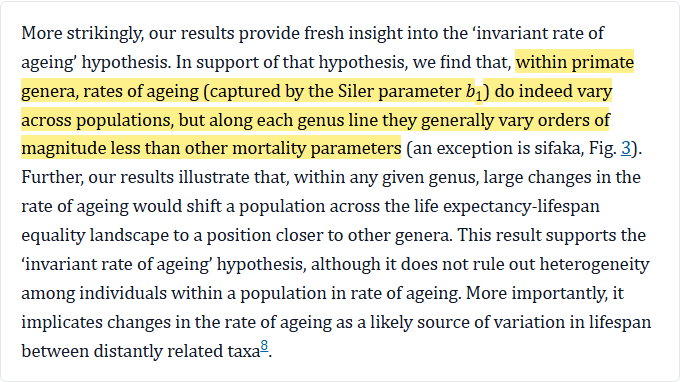
colchero2021-html-a2415e418e.png “In support of that hypothesis, we find that, within primate genera, rates of ageing (captured by the Siler parameter b1) do indeed vary across populations, but along each genus line they generally vary orders of magnitude less than other mortality parameters (an exception is sifaka, Fig. 3).”
- Harrison DE, Archer JR (1987). “Genetic differences in effects of food restriction on aging in mice”. Journal of Nutrition. 117(2):376–382. doi:10.1093/jn/117.2.376. PMID 3559752.↩↩2↩3↩4Info
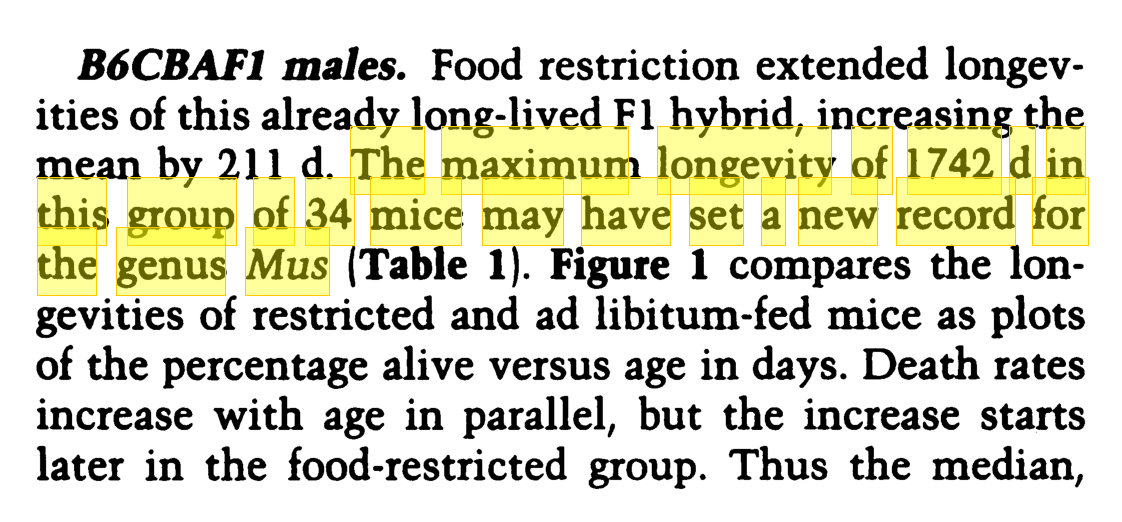
harrison-and-archer-1987-genetic-differences-in-effects-of-food-restriction-on-aging-in-mice-p3-b18-a1d15db08f.png “B6CBAF1 males. Food restriction extended longevities of this already long-lived F1 hybrid, increasing the mean by 211 d. The maximum longevity of 1742 d in this group of 34 mice may have set a new record for the genus Mus (Table 1).” (Table 1 footnote on p. 378 notes: “The longest-lived mouse was fed ad libitum from 1541 to 1742 d.”)
- Weindruch R, Walford RL, Fligiel S, Guthrie D (1986). “The retardation of aging in mice by dietary restriction: longevity, cancer, immunity and lifetime energy intake”. Journal of Nutrition. 116(4):641–654. doi:10.1093/jn/116.4.641. PMID 3958810. ↩↩2↩3
- Ross MH (1961). “Length of life and nutrition in the rat”. Journal of Nutrition. 75(2):197–210. doi:10.1093/jn/75.2.197. PMID 14494200. ↩↩2
- Dong X, Milholland B, Vijg J (2016). “Evidence for a limit to human lifespan”. Nature. 538(7624):257–259. doi:10.1038/nature19793. PMID 27706136. ↩↩2↩3
- Di Francesco A, et al. (2024). “Dietary restriction impacts health and lifespan of genetically diverse mice”. Nature. 634:684–692. doi:10.1038/s41586-024-08026-3. PMID 39385029. PMCID PMC11485257.↩↩2Info
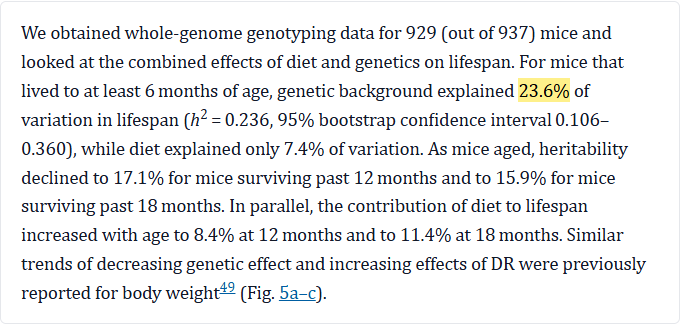
difrancesco2024-html-3811eab355.png “We obtained whole-genome genotyping data for 929 (out of 937) mice and looked at the combined effects of diet and genetics on lifespan. For mice that lived to at least 6 months of age, genetic background explained 23.6% of variation in lifespan (h2 = 0.236, 95% bootstrap confidence interval 0.106–0.360), while diet explained only 7.4% of variation. As mice aged, heritability declined to 17.1% for mice surviving past 12 months and to 15.9% for mice surviving past 18 months. In parallel, the contribution of diet to lifespan increased with age to 8.4% at 12 months and to 11.4% at 18 months.”
- Ayyadevara S, Alla R, Thaden JJ, Shmookler Reis RJ (2008). “Remarkable longevity and stress resistance of nematode PI3K-null mutants”. Aging Cell. 7(1):13–22. doi:10.1111/j.1474-9726.2007.00348.x. PMID 17996009. ↩