Weismann Barrier
The Weismann barrier separates the immortal germ-cell lineages that produce gametes from the disposable somatic cells of the animal body. August Weismann introduced the principle in 1892 against Charles Darwin’s pangenesis hypothesis.1
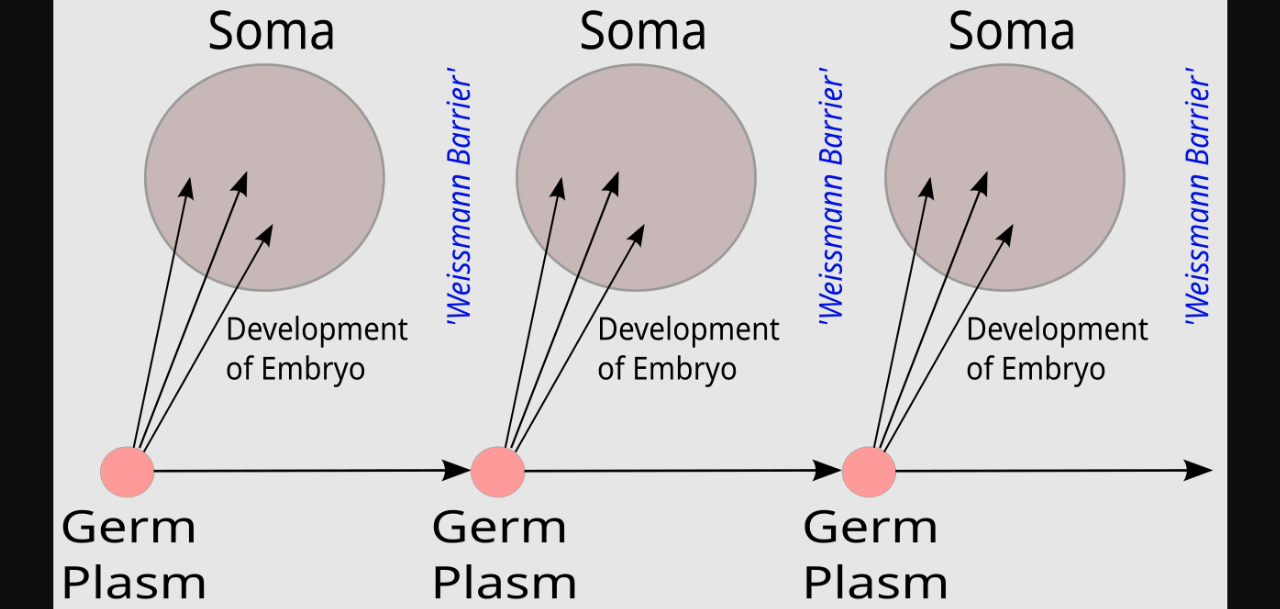
Hereditary information flows one way: from germline cells into somatic cells. Because somatic cells never pass their mutations back to the germline, offspring do not inherit acquired somatic changes.2
Weismann set out the concept in 1892.1 Combined with his late-nineteenth-century germ-plasm theory, biologists call this doctrine Weismannism.3 Some authors contrast Weismannist development, which sequesters a dedicated germline early, with somatic embryogenesis.4
The Weismann barrier reshaped nineteenth-century evolutionary biology by ruling out Lamarckian inheritance of somatic modifications.3 Modern work on horizontal gene transfer and late germline segregation qualifies the barrier across the tree of life.5
Formally: “the developmental strategy must allow germ-role cells to give rise to soma-role cells … and must forbid soma-role cells to give rise to germ-role cells”.6
Exceptions
Basal animals
Basal animals such as sponges (Porifera) and corals (Anthozoa) maintain multipotent stem-cell lineages that generate both somatic and reproductive cells. Strict germline sequestration evolved later within Bilateria.7
Plants
In plants, somatic mutations regularly enter the germline because floral meristems develop from vegetative somatic shoots that have divided for years under natural selection.8 Adult plants also produce large numbers of seeds across multiple seasons.
The barrier is therefore a matter of timing as much as cell type. A selfish mutation reaches the next generation only if it occurs before germline sequestration, arises inside the germline or meristem, or occurs in an organism without a sequestered germline.9
Evolution of the barrier
Mathematical models show that irreversible somatic differentiation evolves when three conditions hold: cell differentiation is costly, a small number of vegetative cells markedly improves organismal performance, and the organism is large enough.10 Under those conditions, blocking somatic cells from re-entering the germline prevents somatic defectors from invading the next generation.11
History
George John Romanes named and first systematically critiqued the doctrine in 1893 (An Examination of Weismannism). He noted that Darwin had considered germ-plasm continuity as a logical alternative to pangenesis, and that Francis Galton had anticipated Weismann’s rejection of acquired characters a decade earlier.3 Romanes also highlighted the main contemporary objection: plant and animal grafting experiments where host germ cells appeared to acquire donor traits, a line of evidence he noted Weismann and his followers had disregarded.12
See also
Citations
Footnotes
- Weismann A. The Germ-Plasm: A Theory of Heredity. Translated by W. Newton Parker and Harriet Rönnfeldt. Charles Scribner’s Sons; 1893. Internet Archive scan. Also see Zou Y. “The Germ-Plasm: the Theory of Heredity (1893), by August Weismann”. Embryo Project Encyclopedia. 2015.↩↩2Primary source excerpt (Weismann, 1893 — preface)
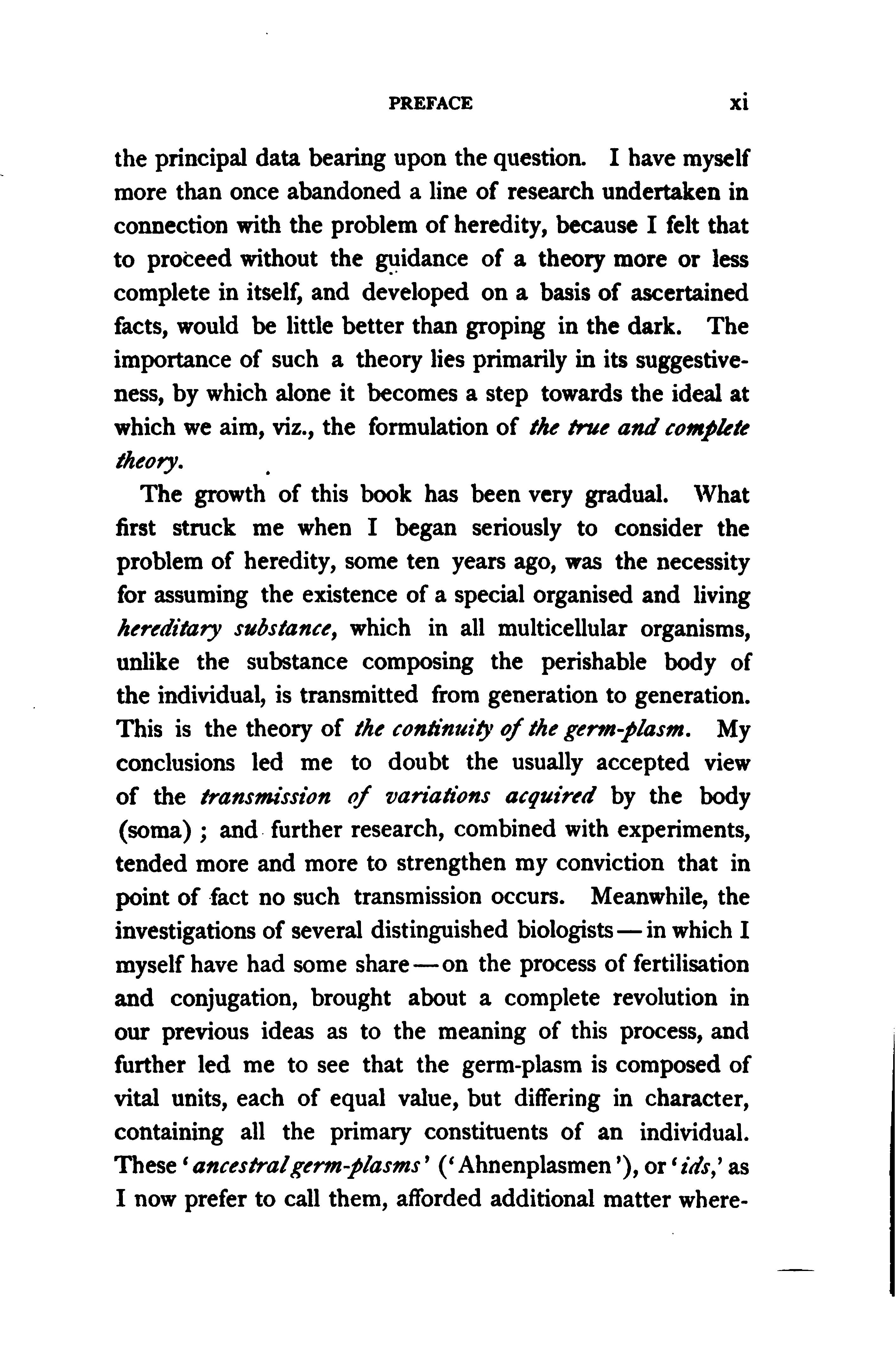
weismann-barrier-weismann-1893-preface.jpg “a special organised and living hereditary substance, which in all multicellular organisms, unlike the substance composing the perishable body of the individual, is transmitted from generation to generation. This is the theory of the continuity of the germ-plasm.” (preface, p. xi)
- Gauthier P. “Does Weismann’s Experiment Constitute a Refutation of the Lamarckian Hypothesis?” BIOS. 1990;61(1/2):6–8. JSTOR 4608123. See also De Tiege A, Tanghe K, Braeckman J, Van de Peer Y. “From DNA- to NA-centrism and the conditions for gene-centrism revisited.” Biology & Philosophy. 2014;29(1):55–69. The barrier concept does not refer to the central dogma of molecular biology; both hypotheses relate to a gene-centric view of life. ↩
- Romanes GJ. An Examination of Weismannism. Chicago: Open Court; 1893.↩↩2↩3Primary source excerpt (Romanes, 1893 — continuity as alternative; Galton's anticipation)
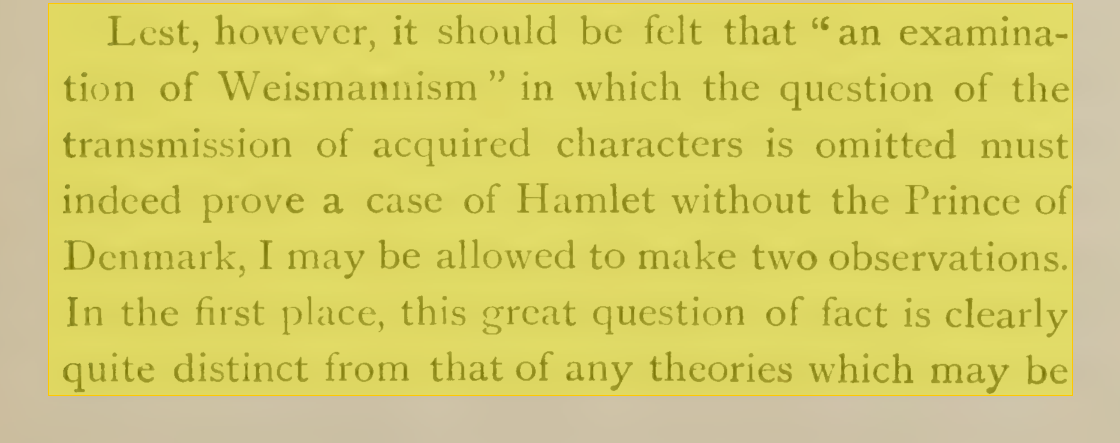
romanes1893-p17-b2.png “the idea of what is now called a ‘continuity of germ-plasm’ was present to Darwin’s mind as a logically possible alternative to the one which he adopted in his theory of pangenesis … Galton’s ‘Theory of Heredity’ presented … the question of the transmission of acquired characters, and answered it in almost exactly the same manner as Weismann did about ten years later.”
- Ridley M. Evolution. 3rd ed. Blackwell; 2004. pp. 295–297. ↩
- Lindley RA. “How Mutational and Epigenetic Changes Enable Adaptive Evolution.” G.I.T. Laboratory Journal. Archived 2011-08-29. Retrieved 2018-09-07. ↩
- Gao Y, Park HJ, Traulsen A, Pichugin Y. “Evolution of irreversible somatic differentiation.” eLife. 2021;10:e66711. doi:10.7554/eLife.66711.↩Primary source excerpt (Gao et al., 2021 — strict rule)
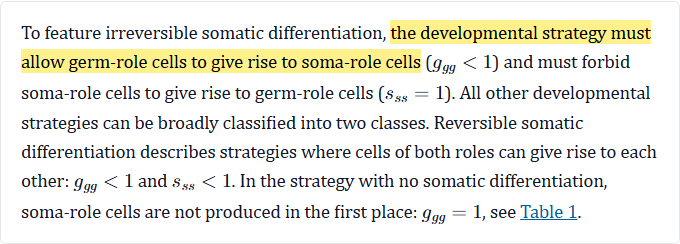
gao2021-html-02a56a031a.png “the developmental strategy must allow germ-role cells to give rise to soma-role cells … and must forbid soma-role cells to give rise to germ-role cells.”
- Radzvilavicius AL, Hadjivasiliou Z, Pomiankowski A, Lane N. “Selection for Mitochondrial Quality Drives Evolution of the Germline.” PLOS Biology. 2016;14(12):e2000410. doi:10.1371/journal.pbio.2000410. ↩
- Whitham TG, Slobodchikoff CN. “Evolution by individuals, plant-herbivore interactions, and mosaics of genetic variability: The adaptive significance of somatic mutations in plants.” Oecologia. 1981;49(3):287–292. doi:10.1007/BF00347587. ↩
- Grosberg RK, Strathmann RR. “The Evolution of Multicellularity: Minor and Major Transitions.” Annual Review of Ecology, Evolution, and Systematics. 2007;38:621–654. doi:10.1146/annurev.ecolsys.36.102403.114735.↩Source excerpt (Grosberg & Strathmann, 2007 — timing)
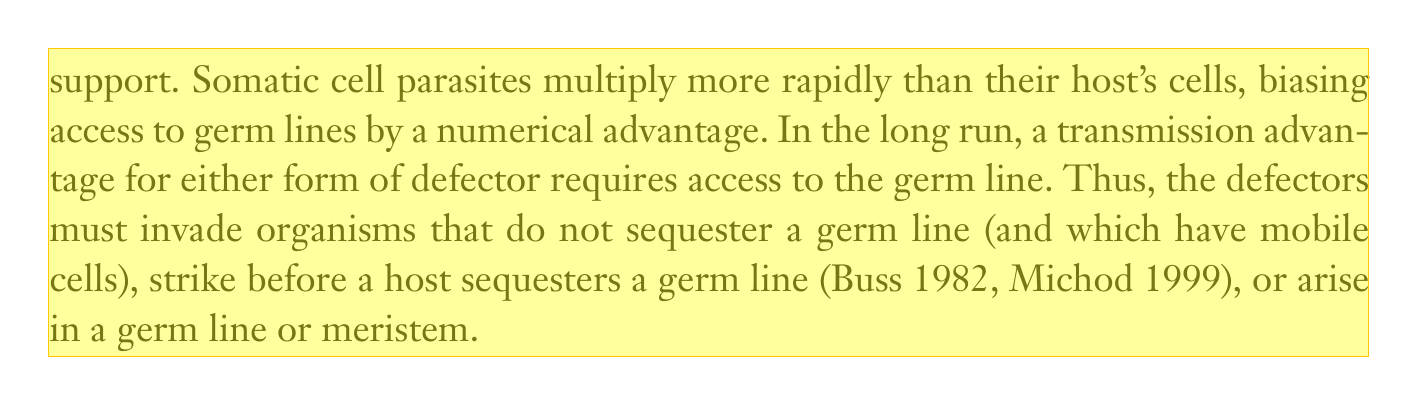
richardk.grosberg2007-p12-b0.png “the defectors must invade organisms that do not sequester a germ line (and which have mobile cells), strike before a host sequesters a germ line, or arise in a germ line or meristem.”
- Gao Y, Park HJ, Traulsen A, Pichugin Y. “Evolution of irreversible somatic differentiation.” eLife. 2021;10:e66711. doi:10.7554/eLife.66711. Three necessary components.↩Primary source excerpt (Gao et al., 2021 — asymmetric differentiation costs)
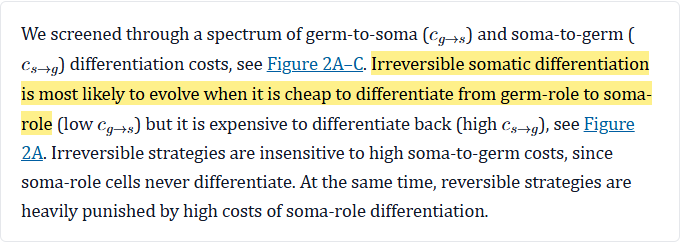
gao2021-html-a0f8193e80.png “Irreversible somatic differentiation is most likely to evolve when it is cheap to differentiate from germ-role to soma-role (low ) but it is expensive to differentiate back (high )”
- Grosberg RK, Strathmann RR. “The Evolution of Multicellularity: Minor and Major Transitions.” Annual Review of Ecology, Evolution, and Systematics. 2007;38:621–654. doi:10.1146/annurev.ecolsys.36.102403.114735. Plant mutants / defector passage.↩Source excerpt (Grosberg & Strathmann, 2007 — plant mutants)
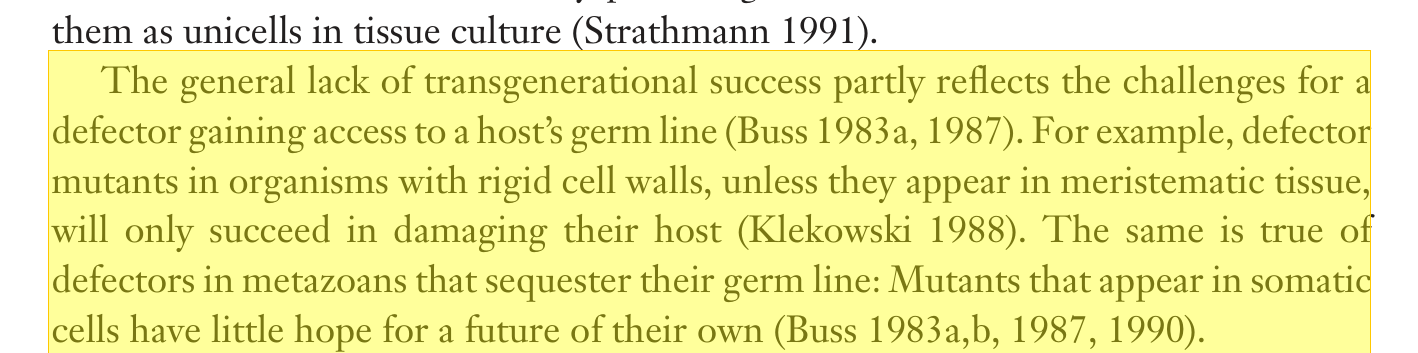
richardk.grosberg2007-p12-b2.png “Defector mutants in organisms with rigid cell walls, unless they appear in meristematic tissue, will only succeed in damaging their host. The same is true of defectors in metazoans that sequester their germ line: Mutants that appear in somatic cells have little hope for a future of their own.”
- Romanes GJ. An Examination of Weismannism. Chicago: Open Court; 1893. Grafting episode.↩Primary source excerpt (Romanes, 1893 — grafting)
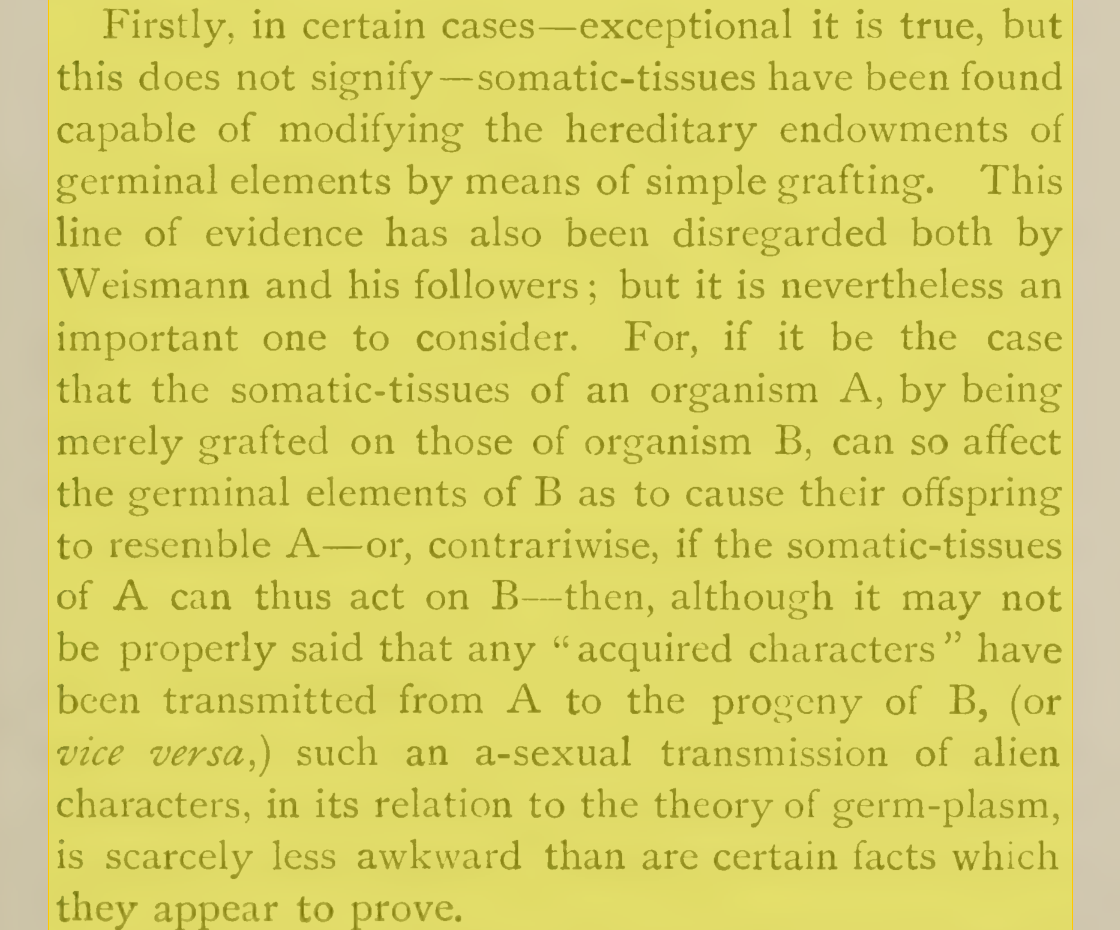
romanes1893-p101-b3.png “Firstly, in certain cases—exceptional it is true, but this does not signify—somatic-tissues have been found capable of modifying the hereditary endowments of germinal elements by means of simple grafting. This line of evidence has also been disregarded both by Weismann and his followers … For, if it be the case that the somatic-tissues of an organism A, by being merely grafted on those of organism B, can so affect the germinal elements of B as to cause their offspring to resemble A—or, contrariwise, if the somatic-tissues of A can thus act on B—then, although it may not be properly said that any ‘acquired characters’ have been transmitted from A to the progeny of B, such an a-sexual transmission of alien characters, in its relation to the theory of germ-plasm, is scarcely less awkward.”