Indeterminate growth
Indeterminate growth is a life-history pattern where an organism continues growing after sexual maturity without stopping at a fixed adult size.12 The pattern is common across plants and cold-blooded vertebrates. It contrasts with determinate adult size in birds and mammals, and with the fixed adult cell number of eutely.12
In evolutionary theories of aging, continued adult growth matters when larger body size raises later fecundity or lowers predation risk. Higher late-life fertility lifts the reproductive value of older individuals and strengthens natural selection at advanced ages.134 Comparative life tables confirm flat or declining mortality in many plants, corals, and ectothermic reptiles, while also showing that continued adult growth can occur alongside ordinary senescence and cellular wear.567
Definition and variation
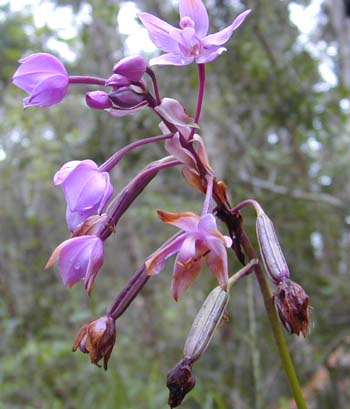
Growth form applies across scales. A single flowering shoot can grow indeterminately even though the whole plant eventually dies. In life-history biology, the unit of classification is the entire organism and the reference threshold is sexual maturity.12
Determinate growth reaches an endpoint encoded in the organism’s normal developmental program. Adult birds and mammals still divide somatic cells to replace blood, skin, and gut linings after whole-body size stabilizes. Indeterminate growth refers specifically to the trajectory of body size across adulthood. Growth proceeds rapidly before sexual maturity and continues more slowly after maturity across many plants, corals, molluscs, crustaceans, insects, fish, amphibians, and reptiles.12
Continued adult growth can slow sharply in old age, and external hazards often end a growth trajectory that lacks a fixed developmental limit. Because species fall along a continuum from organisms that mature near maximum size to species that mature while still small, comparative studies often measure size at maturity divided by maximum adult size as a continuous trait.8
Growth, fecundity, and reproductive value
After sexual maturity, acquired energy supports somatic maintenance, immediate reproduction, or additional body growth. Energy shifts toward continued growth when a larger body can produce or provision more offspring later. In size-dependent life-history models formalized by James Vaupel and colleagues in 2004, reducing present reproduction can increase lifetime fitness when extra growth markedly raises future fecundity.39
Two conditions must hold: survival must allow another growth period, and larger body size must increase later fecundity. When both conditions hold, large older individuals produce far more offspring per breeding event than newly mature adults. George Williams used this size–fecundity relationship in 1957 to predict slower senescence in species with continued adult growth.1
The demographic quantity linking adult growth to natural selection is reproductive value, an individual’s expected contribution to future generations from its current age and size. Under the classical selection shadow, declining survival leaves few old individuals in the population and weakens natural selection against late-acting damage. When fecundity rises steeply with adult size and age, older size classes produce a larger share of future offspring and strengthen natural selection for survival at older ages.34 This evolutionary framework explains how adult growth raises the selective value of late survival, while leaving open which cellular repair mechanisms any given species evolves.4
Demographic patterns of senescence
Population biologists measure senescence along two axes: actuarial senescence, an age-related rise in mortality risk after maturity, and reproductive senescence, an age-related decline in fertility.10 Those two curves often diverge. Across the tree of life, fertility can hold steady or rise while mortality changes, and mortality can flatten while fertility shifts.11
Broad comparative life tables partially support the growth–fecundity prediction. Across a 2014 comparative survey spanning animals and plants, species with indeterminate growth frequently showed roughly constant or slightly declining mortality alongside constant or rising fertility.5 A 2021 synthesis reported little evidence of rising mortality across 98% of studied plant species and all studied corals in its dataset, alongside declining mortality in the South American river turtle (Podocnemis expansa).8 Similarly, a 2022 comparative study of 107 wild populations of 77 ectothermic reptile and amphibian species found negligible or near-zero aging in at least one species within every major ectotherm group (including turtles, crocodilians, and salamanders), with protective armor and slow life histories contributing alongside continued growth.7
Outcomes vary widely. Many fish, reptiles, and invertebrates with continued adult growth display positive actuarial senescence, and fertility curves often diverge from survival curves.811
Conceptual limits
An organism without a fixed adult size endpoint can add small growth increments each year while staying exposed to disease, injury, predation, and tissue wear. Continued adult growth and prolonged survival remain separate biological traits.
In particular, negative actuarial senescence (a statistical decline in population mortality rate with advancing age) reflects demographic hazard curves alongside physiological condition.36 When a tree or reptile exhibits falling mortality as its size increases, the mortality curve combines physiological state with cohort selection, reduced predation on larger bodies, competition, and habitat shifts.6 Evaluating the evolutionary effect of indeterminate growth requires measuring body growth, mortality, fertility, and tissue wear separately.611
See also
- eutely
- Weismann Barrier
- Selection shadow
- Antagonistic pleiotropy
- Mortality rate models
- Research Gaps — Cnidarian Longevity & Rejuvenation
References
Footnotes
- Williams GC (1957). “Pleiotropy, natural selection, and the evolution of senescence”. Evolution. 11 (4): 398–411. doi:10.1111/j.1558-5646.1957.tb02911.x↩↩2↩3↩4↩5↩6Info
georgec.williams1957-p8-b5.png “Many organisms, such as rotifers, most insects, and warm-blooded vertebrates grow very little after reaching maturity. Others, such as mollusks, most crustacea, and most cold-blooded vertebrates continue to grow at an appreciable rate long after sexual maturity, perhaps throughout life. Such an increase in size is accompanied by an increase in fecundity.”
- Roper M, Capdevila P, Salguero-Gómez R (2021). “Senescence: why and where selection gradients might not decline with age”. Proceedings of the Royal Society B. 288 (1955): 20210851. doi:10.1098/rspb.2021.0851↩↩2↩3↩4Info
markroper2021-p6-b4-taxa.png “Spanning across taxa, many stage-categorized species have the capacity to grow indefinitely. Extremely common in plants, indeterminate growth is also found in insects, fish, reptiles and corals.”
- Vaupel JW, Baudisch A, Dölling M, Roach DA, Gampe J (2004). “The case for negative senescence”. Theoretical Population Biology. 65 (4): 339–351. doi:10.1016/j.tpb.2003.12.003↩↩2↩3↩4
- Roper M, Capdevila P, Salguero-Gómez R (2021). “Senescence: why and where selection gradients might not decline with age”. Proceedings of the Royal Society B. 288 (1955): 20210851. doi:10.1098/rspb.2021.0851↩↩2↩3Info
markroper2021-p6-b7.png “If reproduction is much lower at younger, mature ages (lower sizes) and increases disproportionately with size and age, then the relative reproductive value of older ages classes and the abundance of mothers will be biased towards older age classes. Growth and increasing reproductive capacity with age provide just one mechanism to alter a population’s reproductive value and stable age distributions in favour of delaying senescence.”
- Jones OR, Scheuerlein A, Salguero-Gómez R, Camarda CG, Schaible R, et al. (2014). “Diversity of ageing across the tree of life”. Nature. 505 (7482): 169–173. doi:10.1038/nature12789↩↩2Info
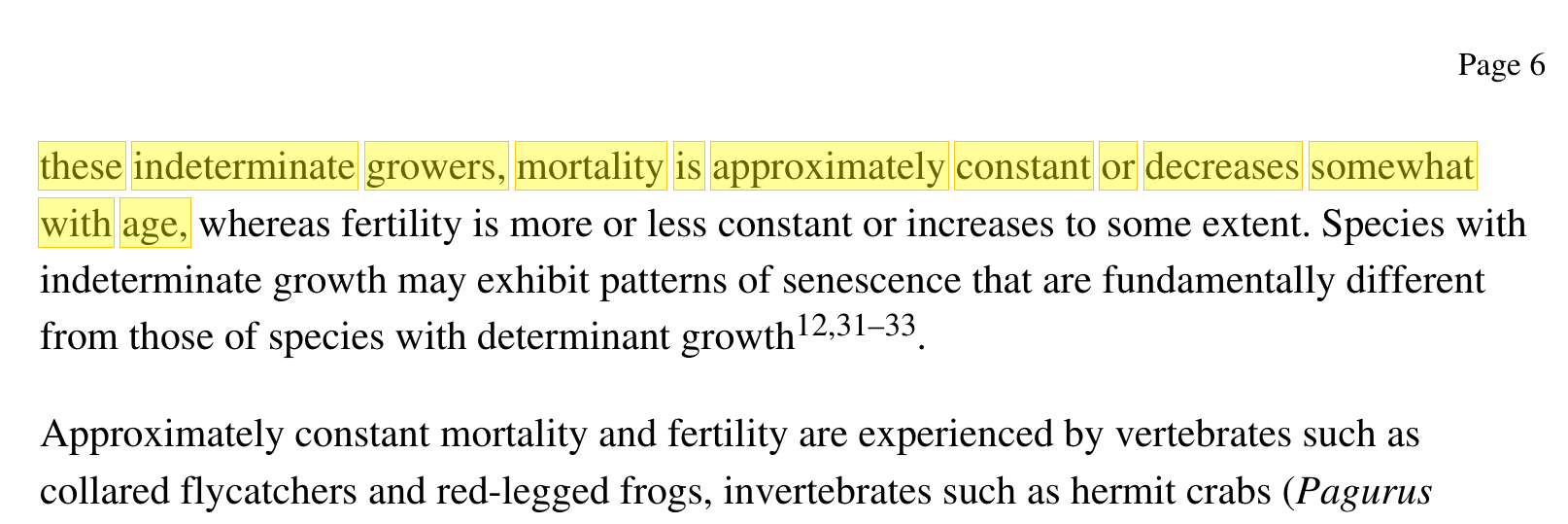
jones2014-p6-b0-aec5885d4e.png “[In] these indeterminate growers, mortality is approximately constant or decreases somewhat with age, whereas fertility is more or less constant or increases to some extent. Species with indeterminate growth may exhibit patterns of senescence that are fundamentally different from those of species with determinant growth.”
- Cohen AA, Legault V, Fülöp T (2020). “What if there’s no such thing as ‘aging’?”. Mechanisms of Ageing and Development. 192: 111344. doi:10.1016/j.mad.2020.111344↩↩2↩3↩4Info
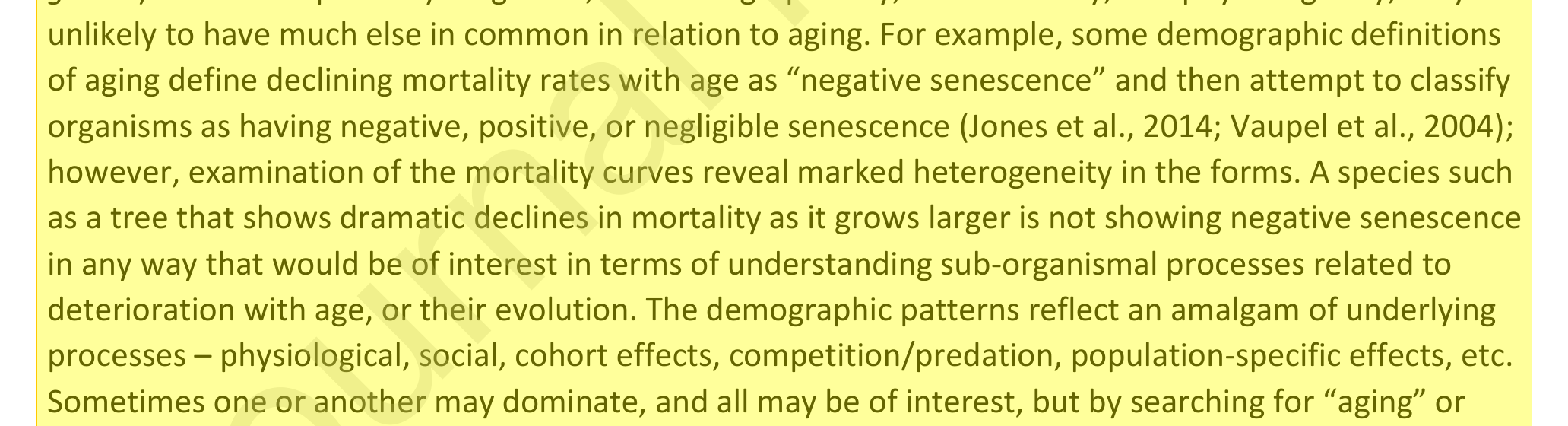
cohen2020a-p12-b2-focused.png “A species such as a tree that shows dramatic declines in mortality as it grows larger is not showing negative senescence in any way that would be of interest in terms of understanding sub-organismal processes related to deterioration with age, or their evolution. The demographic patterns reflect an amalgam of underlying processes - physiological, social, cohort effects, competition/predation, population-specific effects, etc.”
- Reinke BA, Cayuela H, Janzen FJ, Lemaître J-F, Gaillard J-M, et al. (2022). “Diverse aging rates in ectothermic tetrapods provide insights for the evolution of aging and longevity”. Science. 376 (6600): 1459–1466. doi:10.1126/science.abm0151↩↩2
- Roper M, Capdevila P, Salguero-Gómez R (2021). “Senescence: why and where selection gradients might not decline with age”. Proceedings of the Royal Society B. 288 (1955): 20210851. doi:10.1098/rspb.2021.0851↩↩2↩3Info
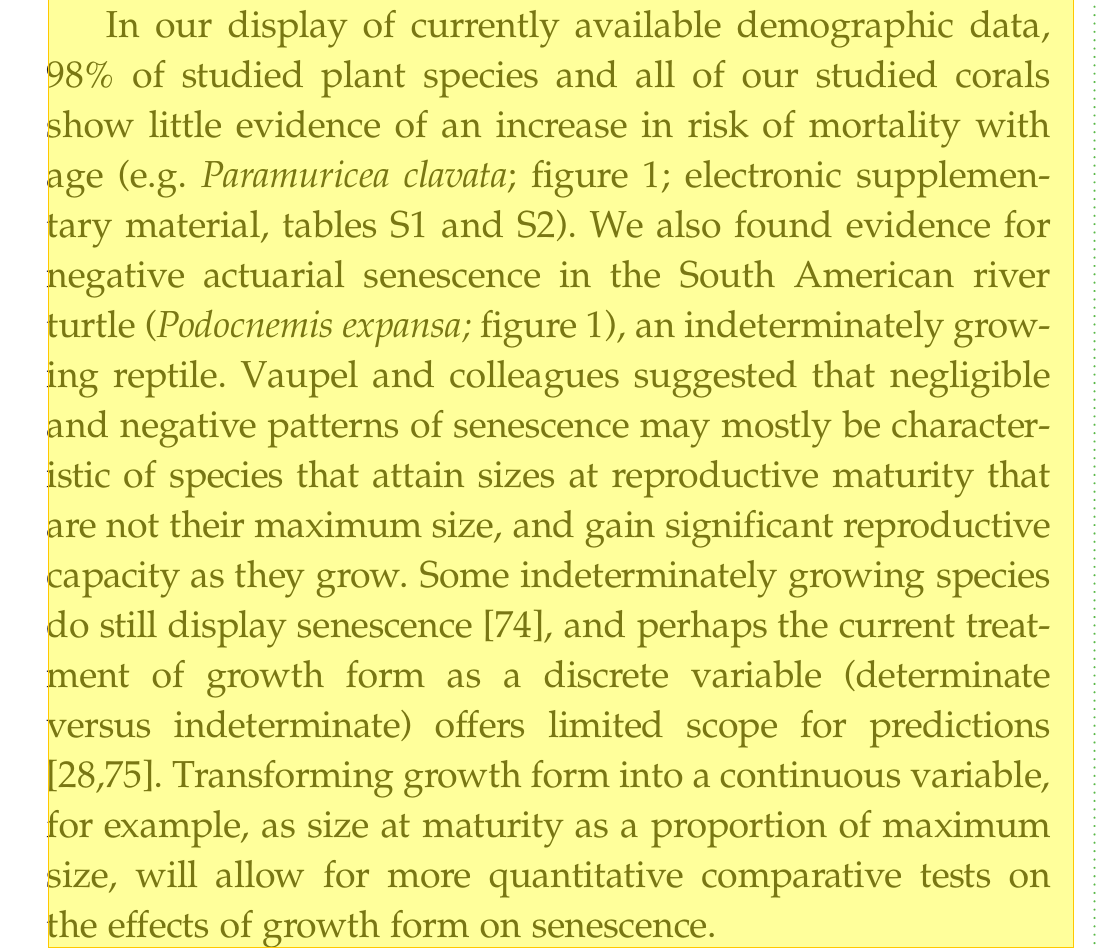
markroper2021-p6-b6.png “In our display of currently available demographic data, 98% of studied plant species and all of our studied corals show little evidence of an increase in risk of mortality with age… Some indeterminately growing species do still display senescence… Transforming growth form into a continuous variable, for example, as size at maturity as a proportion of maximum size, will allow for more quantitative comparative tests on the effects of growth form on senescence.”
- Roper M, Capdevila P, Salguero-Gómez R (2021). “Senescence: why and where selection gradients might not decline with age”. Proceedings of the Royal Society B. 288 (1955): 20210851. doi:10.1098/rspb.2021.0851↩Info
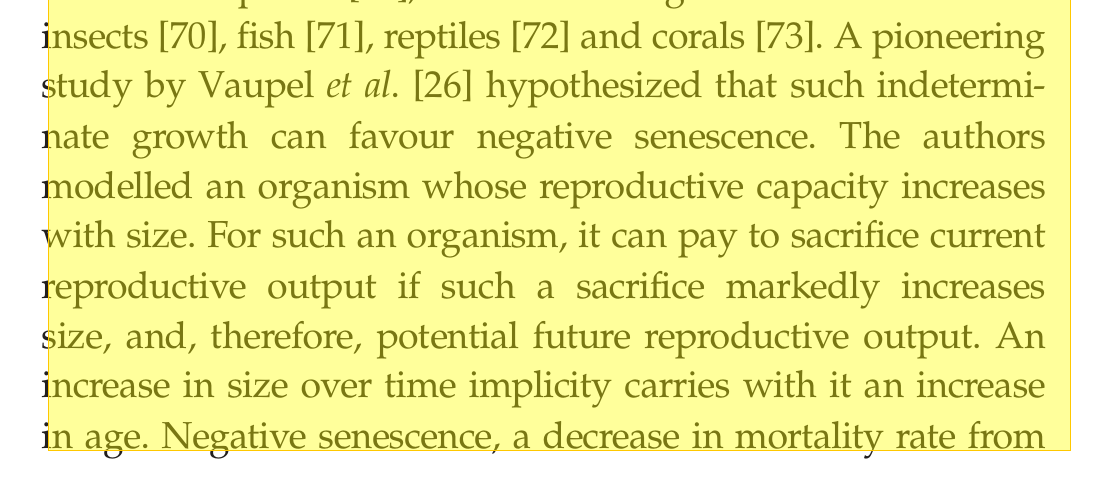
markroper2021-p6-b4-model.png “The authors modelled an organism whose reproductive capacity increases with size. For such an organism, it can pay to sacrifice current reproductive output if such a sacrifice markedly increases size, and, therefore, potential future reproductive output.”
- Roper M, Capdevila P, Salguero-Gómez R (2021). “Senescence: why and where selection gradients might not decline with age”. Proceedings of the Royal Society B. 288 (1955): 20210851. doi:10.1098/rspb.2021.0851↩Info
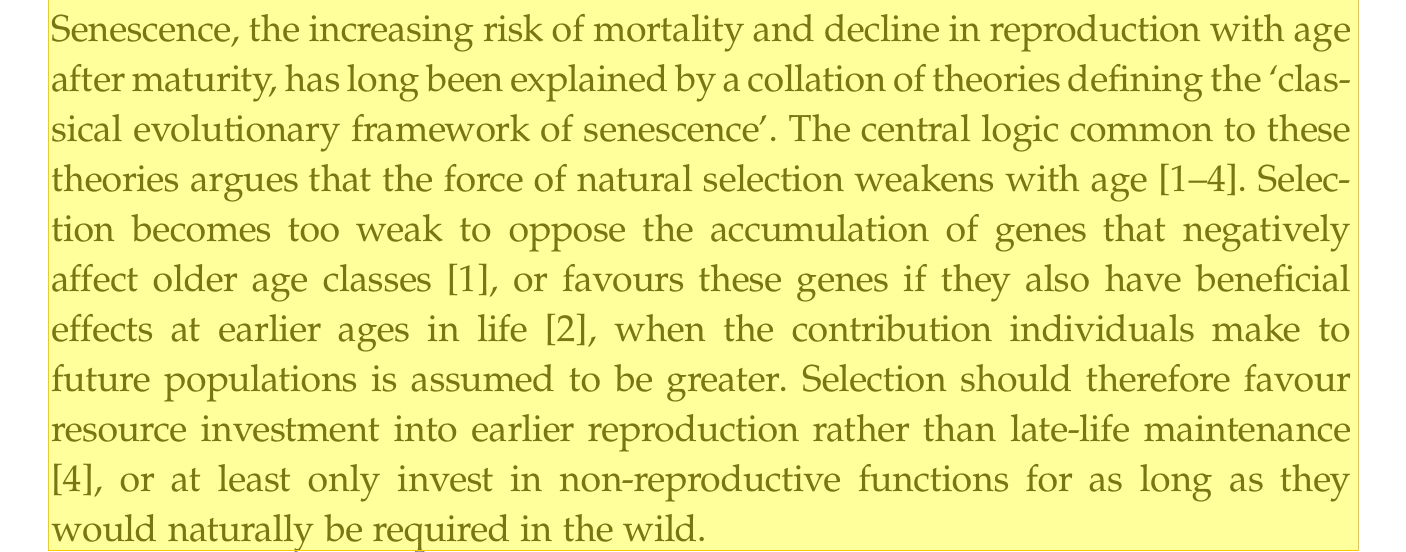
markroper2021-p1-b17.png “Senescence, the increasing risk of mortality and decline in reproduction with age after maturity, has long been explained by a collation of theories defining the ‘classical evolutionary framework of senescence’.”
- Roper M, Capdevila P, Salguero-Gómez R (2021). “Senescence: why and where selection gradients might not decline with age”. Proceedings of the Royal Society B. 288 (1955): 20210851. doi:10.1098/rspb.2021.0851↩↩2↩3Info
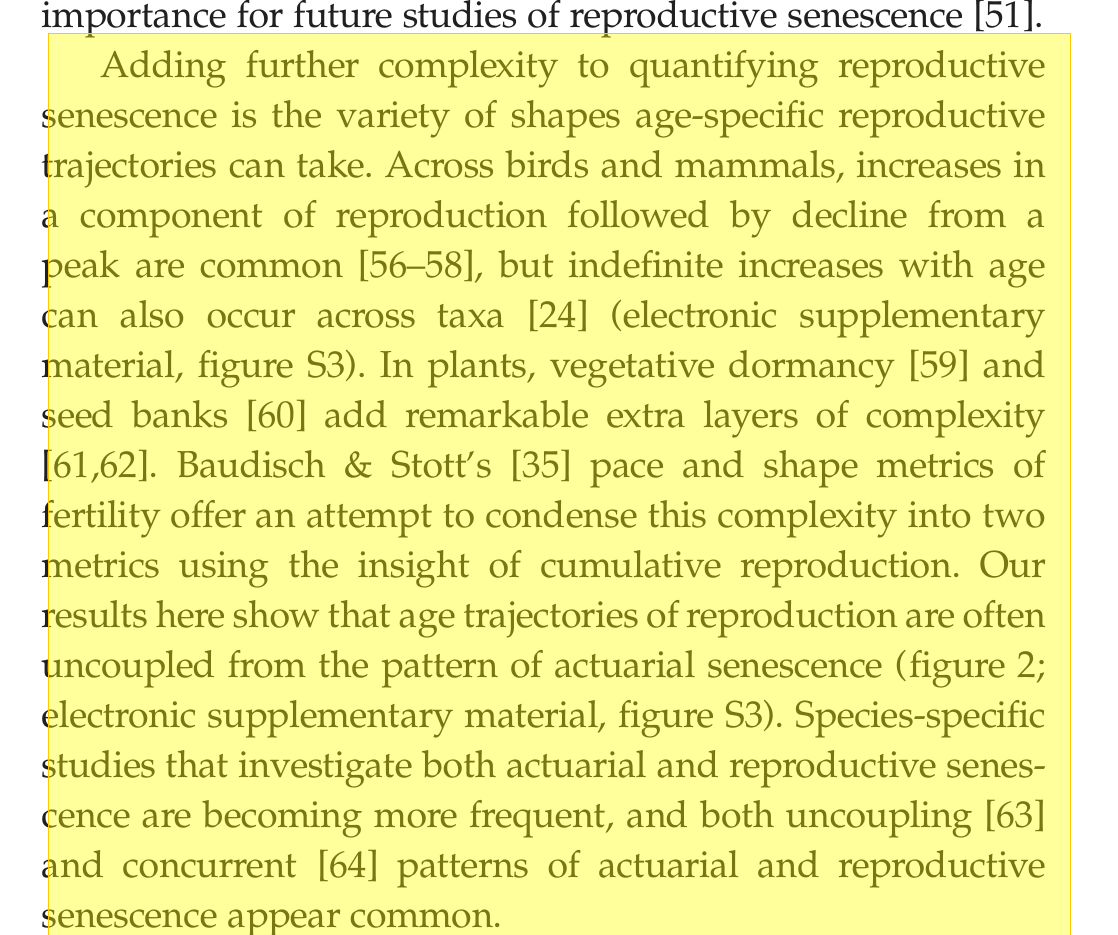
markroper2021-p6-b1.png “Our results here show that age trajectories of reproduction are often uncoupled from the pattern of actuarial senescence… both uncoupling and concurrent patterns of actuarial and reproductive senescence appear common.”