Adaptive therapy
Adaptive therapy is a cancer treatment strategy that modulates drug dosing to keep tumor burden stable rather than attempting total eradication.1 Developed by Robert Gatenby and collaborators, the protocol retains a population of drug-sensitive tumor cells to suppress drug-resistant subclones through resource competition.1
Evolutionary and game-theoretic basis
Continuous maximum-tolerated-dose (MTD) chemotherapy imposes intense selection for resistant subclones while killing the drug-sensitive cells that normally compete with them for oxygen, glucose, and space—an ecological process called competitive release.1 Adaptive dosing withdraws treatment once tumor burden falls below a target threshold and resumes only when sensitive cells regrow, keeping resistant cells under resource competition rather than driving them to fixation.1
Formalizations with evolutionary ecologist Joel Brown frame the clinician–tumor interaction as a Stackelberg evolutionary game, an asymmetric leader–follower contest:23
- The physician acts as leader, dynamically adjusting dosing schedules in response to real-time tumor burden metrics (such as serum PSA or imaging).
- Tumor clones act as followers, adapting their phenotypic frequencies along Lotka–Volterra competitive dynamics under the drug-imposed fitness landscape.
Fixed continuous regimens ignore the follower response and subject cancer cells to a predictable selection force, ceding evolutionary control to resistant clones.2 By varying or pausing treatment as tumor composition shifts, the physician exploits competitive asymmetry between sensitive and resistant cells to prolong tumor control.23
Clinical evidence
The first clinical trial of adaptive therapy tested intermittent abiraterone acetate (a CYP17A1 androgen-synthesis inhibitor) in men with metastatic castration-resistant prostate cancer using serum prostate-specific antigen (PSA) thresholds.4 Abiraterone was paused whenever a patient’s PSA dropped below 50% of baseline and restarted only when PSA returned to baseline. In the pilot cohort, only 1 of 11 patients progressed during study follow-up, yielding a median radiographic and PSA time to progression of at least 27 months (compared with 16.5 and 11.1 months in historical continuous-dosing controls) while cutting cumulative abiraterone dose to 47% of standard continuous treatment.4
Limits of the approach
Adaptive dosing depends on ecological assumptions that do not hold in every tumor:
- No resistance fitness cost. Competitive suppression works strongest when resistant cells pay a metabolic or proliferative cost in the absence of drug, or remain strongly outcompeted for shared niche space by sensitive cells.14
- Pre-existing pan-resistance or extensive branching. If a tumor already harbors spatially separated lineages with diverse, uncoupled resistance traits, retaining sensitive clones cannot restrain every escaping branch.
- Spatial partitioning. Lotka–Volterra suppression assumes sensitive and resistant cells share local limiting resources. Resistant cells isolated in poorly perfused or distant metastatic sanctuaries feel weak competitive pressure from sensitive populations elsewhere.
- Inadequate real-time biomarkers. Safe cycling requires a fast, reliable proxy of tumor burden (such as PSA in prostate cancer) so disease progression does not occur unnoticed between treatment pauses.
See also
References
Footnotes
- Gatenby RA, Silva AS, Gillies RJ, Frieden BR (2009). “Adaptive therapy”. Cancer Research. 69 (11): 4894–4903. doi:10.1158/0008-5472.CAN-08-3658↩↩2↩3↩4↩5Info
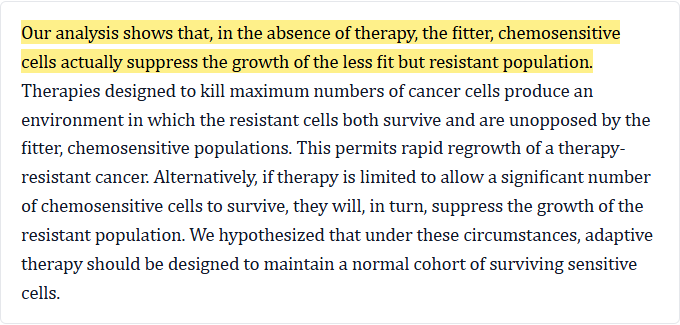
gatenby2009-html-f47a31db7c.png “Our analysis shows that, in the absence of therapy, the fitter, chemosensitive cells actually suppress the growth of the less fit but resistant population. Therapies designed to kill maximum numbers of cancer cells produce an environment in which the resistant cells both survive and are unopposed by the fitter, chemosensitive populations.”
- Staňková K, Brown JS, Dalton WS, Gatenby RA (2019). “Optimizing cancer treatment using game theory: A review”. JAMA Oncology. 5 (1): 96–103. doi:10.1001/jamaoncol.2018.3395↩↩2↩3Info
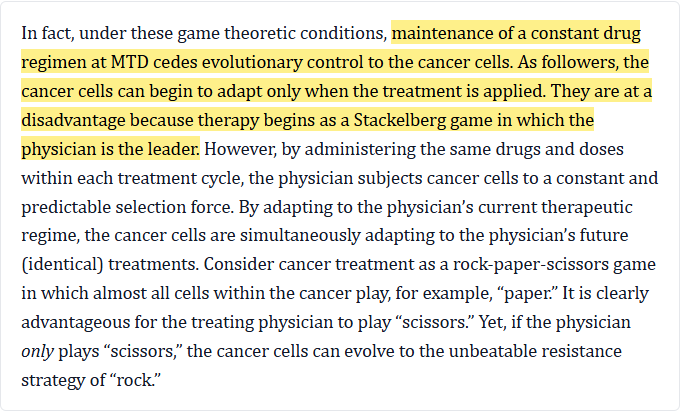
stankova2019-html-8d39102644.png “In fact, under these game theoretic conditions, maintenance of a constant drug regimen at MTD cedes evolutionary control to the cancer cells. As followers, the cancer cells can begin to adapt only when the treatment is applied. They are at a disadvantage because therapy begins as a Stackelberg game in which the physician is the leader.”
- Gatenby RA, Brown JS (2020). “Integrating evolutionary dynamics into cancer therapy”. Nature Reviews Clinical Oncology. 17 (11): 675–686. doi:10.1038/s41571-020-0411-1↩↩2
- Zhang J, Cunningham JJ, Brown JS, Gatenby RA (2017). “Integrating evolutionary dynamics into treatment of metastatic castrate-resistant prostate cancer”. Nature Communications. 8: 1816. doi:10.1038/s41467-017-01968-5↩↩2↩3Info
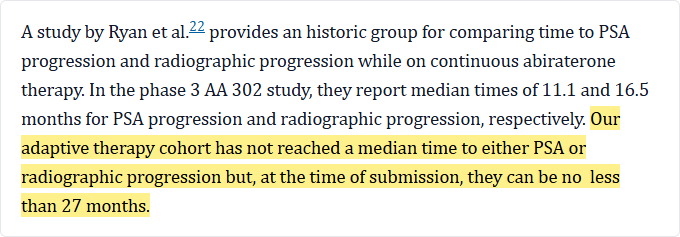
zhang2017-html-166c447fc6.png “In the phase 3 AA 302 study, they report median times of 11.1 and 16.5 months for PSA progression and radiographic progression, respectively. Our adaptive therapy cohort has not reached a median time to either PSA or radiographic progression but, at the time of submission, they can be no less than 27 months.”