Cancer ecology
Cancer ecology examines tumors as evolving ecological communities of competing and cooperating cell phenotypes.12 Within a tumor, subclones interact across gradients of diffusing nutrients and acid waste alongside stromal cells and immune predators.12
Core ecological dynamics
Tumors progress through somatic clonal evolution, as Peter Nowell formulated in 1976. An ecological perspective adds that clonal fitness is never purely cell-intrinsic; it depends on population frequencies and how cells interact with one another and remodel their local habitat:
- Eco-evolutionary selection. Population-ecology forces—resource competition, predation by immune surveillance, parasitism, and habitat remodeling—govern neoplastic progression alongside mutation rate, determining which subclones expand or persist.1
- Public-goods cooperation and nonlinear stable coexistence. Tumor cells need not acquire every hallmark capability autonomously. Subclones secreting diffusible growth factors, angiogenic signals, or matrix-degrading proteases supply shared local public goods that allow neighboring clones to coexist in byproduct mutualism.3 When the growth benefit of a secreted factor such as IGF-II is a nonlinear (sigmoidal) function of producer frequency, negative frequency-dependent selection maintains a stable polymorphism of producer and non-producer (“free-rider”) subclones even without spatial assortment.4
- Metabolic niche construction (acid-mediated invasion). Constitutive aerobic glycolysis (the Warburg effect) acts as interference competition: intermittent hypoxia selects for high glucose uptake and proton/lactate export, acidifying the peritumoral stroma to kill normal acid-sensitive neighbors and clear space for acid-adapted tumor clones.5
Measuring spatial heterogeneity: the Evo-index and Eco-index
Ecological diversity metrics predict clinical progression independently of individual driver mutations. In prospective cohorts of Barrett’s esophagus, higher clonal diversity within biopsies strongly predicted progression to esophageal adenocarcinoma.6 Multi-timepoint single-crypt genotyping later showed that genome doubling and elevated chromosomal aberration (SCA) loads appear roughly four years before progression, while clones with few alterations persist alongside unstable clones in a dynamic spatial equilibrium rather than being swept away by a single dominant clone.7
To standardize clinical forecasting, Carlo Maley and an international consensus panel introduced a two-axis classification system:2
- Evolutionary index (
Evo-index, ): Combines intratumoral subclonal diversity () with the rate of evolutionary change over time () across longitudinal or spatial biopsies, indexing the tumor’s intrinsic evolvability.2 - Ecological index (
Eco-index, ): Combines microenvironmental hazards () (immune predation, toxin accumulation, drug exposure) with resource availability and heterogeneity () (vascular perfusion, hypoxia, stromal support), indexing the extrinsic selective pressures acting on the tumor.2
Implications for therapy
Treating a tumor as an ecosystem changes therapeutic strategy. Standard maximum-tolerated-dose regimens select strongly for resistant phenotypes while eliminating drug-sensitive competitors (competitive release). Evolutionary protocols such as adaptive therapy retain sensitive clones to suppress resistant lineages through resource competition, while public-goods and habitat interventions aim to shift frequency-dependent equilibria or buffer peritumoral acidosis rather than killing cells in isolation.42
See also
- Clonal evolution
- Adaptive therapy
- Multicellular cooperation
- Non-cell-autonomous tumor suppression
- Carlo Maley
References
Footnotes
- Merlo LMF, Pepper JW, Reid BJ, Maley CC (2006). “Cancer as an evolutionary and ecological process”. Nature Reviews Cancer. 6 (12): 924–935. doi:10.1038/nrc2013↩↩2↩3
- Maley CC, Aktipis A, Graham TA, Sottoriva A, Boddy AM, Janiszewska M, Silva AS, Gerlinger M, Yuan Y, Pienta KJ, Anderson KS, Gatenby R, Swanton C, Posada D, Wu CI, Schiffman JD, Hwang ES, Polyak K, Anderson ARA, Brown JS, Greaves M, Shibata D (2017). “Classifying the evolutionary and ecological features of neoplasms”. Nature Reviews Cancer. 17 (10): 605–619. doi:10.1038/nrc.2017.69↩↩2↩3↩4↩5↩6Info
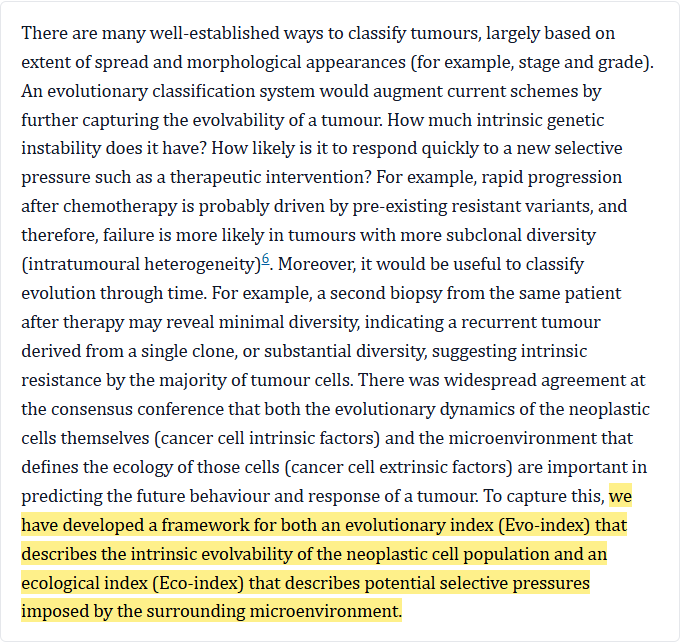
maley2017-html-474d1c6584.png “To capture this, we have developed a framework for both an evolutionary index (Evo-index) that describes the intrinsic evolvability of the neoplastic cell population and an ecological index (Eco-index) that describes potential selective pressures imposed by the surrounding microenvironment.”
- Axelrod R, Axelrod DE, Pienta KJ (2006). “Evolution of cooperation among tumor cells”. Proceedings of the National Academy of Sciences. 103 (36): 13474–13479. doi:10.1073/pnas.0606053103↩Info
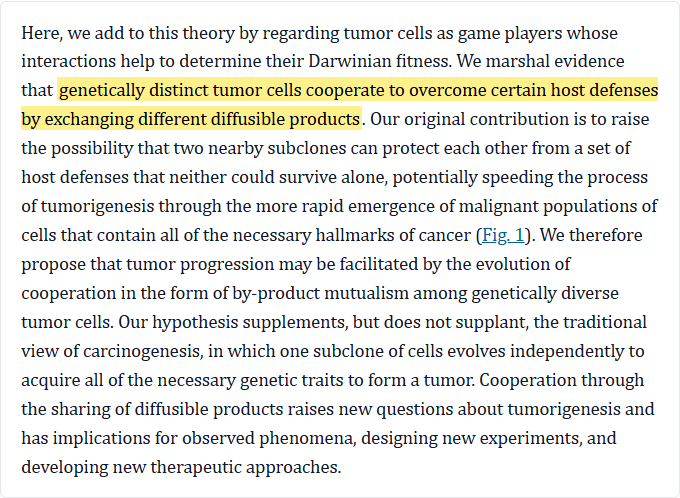
axelrod2006-html-3e06ae294a.png “We marshal evidence that genetically distinct tumor cells cooperate to overcome certain host defenses by exchanging different diffusible products.”
- Archetti M, Ferraro DA, Christofori G (2015). “Heterogeneity for IGF-II production maintained by public goods dynamics in neuroendocrine pancreatic cancer”. Proceedings of the National Academy of Sciences. 112 (6): 1833–1838. doi:10.1073/pnas.1414653112↩↩2Info
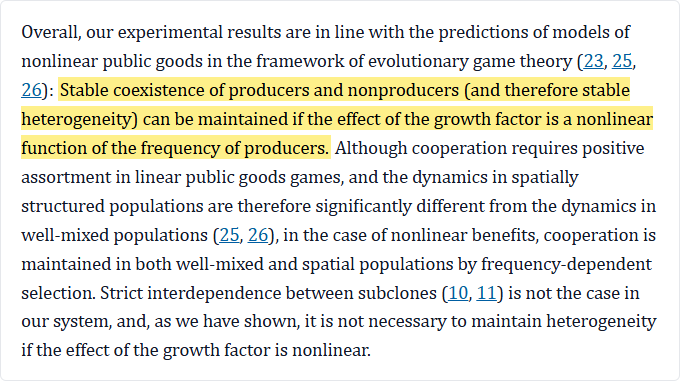
archetti2015-html-839eb901cf.png “Stable coexistence of producers and nonproducers (and therefore stable heterogeneity) can be maintained if the effect of the growth factor is a nonlinear function of the frequency of producers.”
- Gatenby RA, Gillies RJ (2004). “Why do cancers have high aerobic glycolysis?”. Nature Reviews Cancer. 4 (11): 891–899. doi:10.1038/nrc1478↩
- Maley CC, Galipeau PC, Finley JC, Wongsurawat VJ, Li X, Sanchez CA, Paulson TG, Blount PL, Risques RA, Rabinovitch PS, Reid BJ (2006). “Genetic clonal diversity predicts progression to esophageal adenocarcinoma”. Nature Genetics. 38 (4): 468–473. doi:10.1038/ng1768↩
- Martinez P, Mallo D, Paulson TG, Li X, Sanchez CA, Reid BJ, Graham TA, Kuhner MK, Maley CC (2017). “Evolution of Barrett’s esophagus through space and time at single-crypt and whole-biopsy levels”. Nature Communications. 8: 788. doi:10.1038/s41467-017-02621-x↩Info
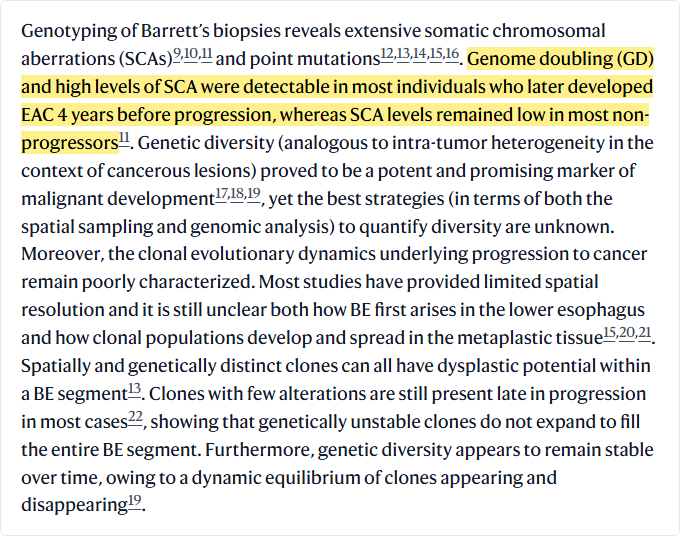
martinez2017-html-85d7e12540.png “Genome doubling (GD) and high levels of SCA were detectable in most individuals who later developed EAC 4 years before progression, whereas SCA levels remained low in most non-progressors… Clones with few alterations are still present late in progression in most cases, showing that genetically unstable clones do not expand to fill the entire BE segment.”