Clonal evolution
Clonal evolution treats a tumor as an adapting population of somatic cells descended from a single ancestor.1 First formulated by Peter Nowell in 1976, the framework describes carcinogenesis as Darwinian evolution inside host tissues.1 Heritable variation arises continuously across cell divisions, and local microenvironmental selection determines which subclones expand.1
The Nowell model
Two coupled processes drive somatic progression:1
- Variation. Genomic instability, replication errors, chromosomal rearrangements, and environmental DNA damage continually generate genetically distinct subpopulations within a single lineage. Mutation supply sets how fast the population samples new phenotypes.
- Selection. Microenvironmental pressures—nutrient scarcity, spatial crowding, immune surveillance, and clinical therapy—determine which variants survive and outcompete neighbors. Genetic instability speeds progression not because instability helps any single cell directly, but because it broadens the supply of selectable variants.1
In Nowell’s formulation, tumorigenesis advances through stepwise and overlapping clonal sweeps: a founder variant gains a proliferative edge, expands, acquires secondary genetic or epigenetic changes, and buds diverging sublines that can survive clinical therapy.1
Pre-neoplastic clonal mosaics in healthy aging tissue
Deep sequencing of healthy human skin, blood, and esophagus showed that somatic clonal evolution begins decades before any clinical tumor appears.2 By middle age, normal esophageal epithelium in humans is colonized by hundreds of positively selected clones per square centimeter carrying driver mutations in NOTCH1 (affecting 30–80% of cells in most elderly donors) and TP53.2
Rather than every positively selected clone marching linearly toward cancer, dense mutant mosaics create intense clonal interference: expanding mutant clones in normal epithelium collide with and physically eliminate most newly formed microscopic tumors.3 Whether a mutant clone progresses or stalls therefore depends on the surrounding tissue fitness landscape (Adaptive oncogenesis) and on non-cell-autonomous suppression by neighboring clones.
Trunk and branch mutations in established tumors
Early textbook diagrams depicted neoplastic progression as a linear succession of mutations shared across every malignant cell. Multiregion sequencing of established tumors overturned that linear picture. Sequencing spatially separated biopsies from primary and metastatic renal cell carcinomas revealed pervasive branched evolution:4
- Trunk mutations arise early in the shared ancestor of the tumor and appear across all sampled regions of the primary mass and its metastases.
- Branch mutations accumulate later along spatially separated lineages and generate coexisting subclones with distinct driver mutations.4 A single patient’s tumor can evolve independent convergent mutations in different regions of the same tumor-suppressor gene (VHL, SETD2, KDM5C, PTEN).4
Single-cell genetic mapping led by Mel Greaves and colleagues demonstrated an analogous branching (“variegated”) architecture in childhood acute lymphoblastic leukemia (ALL), showing that multiple genetically distinct leukemia-propagating subclones coexist prior to diagnosis and treatment.5 A single needle biopsy therefore samples only one terminal branch, risking false confidence that a branch mutation is present throughout the entire tumor.4
Clinical consequences
- Target escape. Targeted drugs aimed at a branch mutation clear only that subclone, leaving trunk-only and parallel-branch lineages intact to repopulate the tumor.4
- Therapy as selection and competitive release. Maximum-tolerated-dose chemotherapy and targeted therapy act as intense selective bottlenecks, killing drug-sensitive competitors and releasing pre-existing resistant sublines from interclonal competition—a failure mode that adaptive therapy aims to prevent.1
- Relapse from minor subclones. Recurrent disease is often seeded not by the dominant pretreatment clone, but by a minor pre-existing branch or ancestral subclone that survives the therapeutic bottleneck.5
See also
- Clonal interference
- Non-cell-autonomous tumor suppression
- Adaptive oncogenesis
- Cancer ecology
- Adaptive therapy
- Peter Nowell
- Mel Greaves
References
Footnotes
- Nowell PC (1976). “The clonal evolution of tumor cell populations”. Science. 194 (4260): 23–28. doi:10.1126/science.959840↩↩2↩3↩4↩5↩6↩7Info
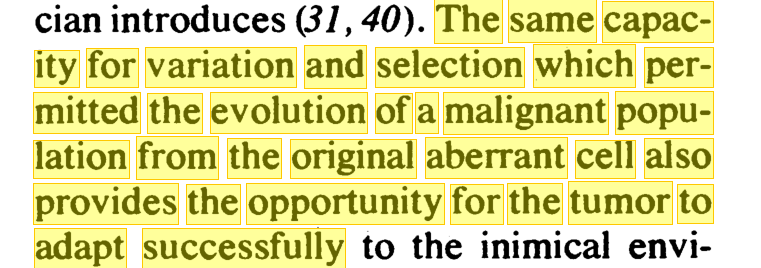
nowell1976-p5-b10-9156ebeb19.png “With variants being continually produced, and even increasing in frequency with tumor progression, the neoplasm possesses a marked capacity for generating mutant sublines, resistant to whatever therapeutic modality the physician introduces (31, 40). The same capacity for variation and selection which permitted the evolution of a malignant population from the original aberrant cell also provides the opportunity for the tumor to adapt successfully to the inimical environment of therapy, to the detriment of the patient.”
- Martincorena I, Fowler JC, Wabik A, Lawson ARJ, Abascal F, et al. (2018). “Somatic mutant clones colonize the human esophagus with age”. Science. 362 (6417): 911–917. doi:10.1126/science.aau3879↩↩2Info
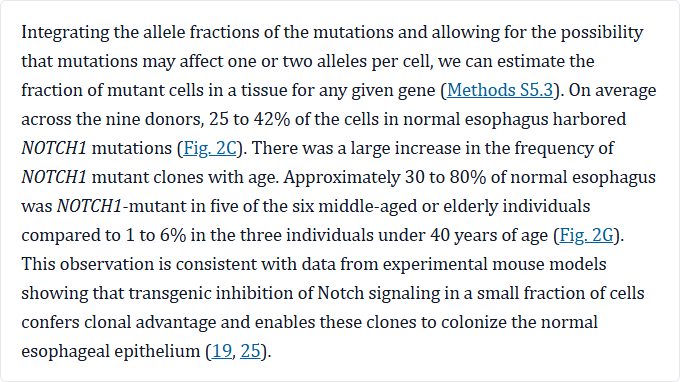
martincorena2018-html-56f8cba623.png “Approximately 30 to 80% of normal esophagus was NOTCH1-mutant in five of the six middle-aged or elderly individuals compared to 1 to 6% in the three individuals under 40 years of age (Fig. 2G).”
- Colom B, Herms A, Hall MWJ, Dentro SC, King C, et al. (2021). “Mutant clones in normal epithelium outcompete and eliminate emerging tumours”. Nature. 598 (7881): 510–514. doi:10.1038/s41586-021-03965-7↩Info
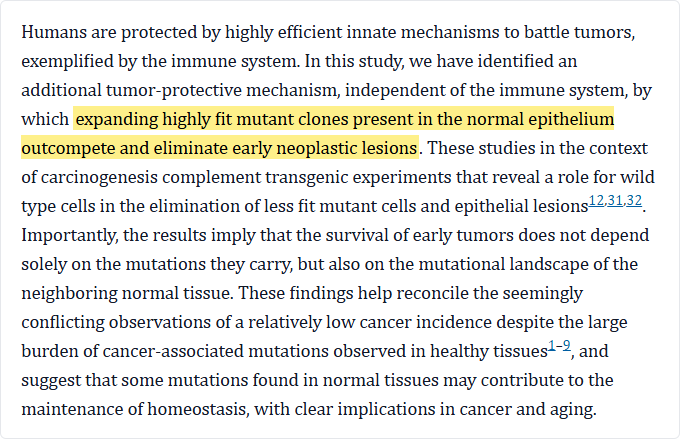
colom2021-html-5709994860.png “In this study, we have identified an additional tumor-protective mechanism, independent of the immune system, by which expanding highly fit mutant clones present in the normal epithelium outcompete and eliminate early neoplastic lesions.”
- Gerlinger M, Rowan AJ, Horswell S, Math M, Larkin J, Endesfelder D, Gronroos E, Martinez P, Matthews N, Stewart A, Tarpey P, Varela I, Phillimore B, Begum S, McDonald NQ, Butler A, Jones D, Raine K, Latimer C, Santos CR, Nohadani M, Eklund AC, Spencer-Dene B, Clark G, Pickering L, Stamp G, Gore M, Szallasi Z, Downward J, Futreal PA, Swanton C (2012). “Intratumor heterogeneity and branched evolution revealed by multiregion sequencing”. New England Journal of Medicine. 366 (10): 883–892. doi:10.1056/NEJMoa1113205↩↩2↩3↩4↩5
- Anderson K, Lutz C, van Delft FW, Bateman CM, Guo Y, Colman SM, Kempski H, Moorman AV, Titley I, Swansbury J, Kearney L, Enver T, Greaves M (2011). “Genetic variegation of clonal architecture and propagating cells in leukaemia”. Nature. 469 (7330): 356–361. doi:10.1038/nature09650↩↩2