Multicellular cooperation
Multicellular cooperation is the set of coordinated cell behaviors that sustains a multicellular body as a single evolutionary individual. Comparative oncology groups these behaviors into the five foundations of multicellularity, which restrain cell growth and maintain shared tissues.1 Somatic cells descend from free-living unicellular ancestors and retain ancestral replicative and metabolic pathways. Overlapping cell-intrinsic and tissue-level policing systems therefore enforce cooperation by penalizing somatic defection (“cheating”).21
Five foundations and universal failure modes
Aktipis and colleagues define the five foundations as proliferation inhibition, regulated cell death, division of labor, resource allocation, and extracellular environment maintenance.1 Comparative surveys across animals, plants, fungi, and algae show that cancer and cancer-like overgrowths map onto breakdowns in these five foundations.1 Across the tree of life, cheating on division of labor—loss of differentiation and disorganized cell masses—appears in every form of multicellularity. Deregulated differentiation is thus a universal vulnerability of multicellular organization.1
Host defenses raise the evolutionary cost of defection through layered policing. These include cell-intrinsic arrest and repair (p53), programmed apoptosis (APAF1 and caspases), replicative limits (telomeres and replicative credit), and extrinsic immune surveillance.2 Investment in cooperation and tumor suppression also follows life-history trade-offs. Fast-life-history phenotypes favor rapid proliferation and plasticity, whereas slow-life-history strategies invest more heavily in somatic maintenance and survival. The same trade-off shapes how clinical dosing schedules select for fast versus slow cancer cell phenotypes.3
Control of cheating in aggregative and clonal multicellularity
Vulnerability to cellular cheating depends sharply on how a multicellular body is assembled. In clonal multicellularity, a single-cell bottleneck aligns genetic interests at the start of development (see De-Darwinization). By contrast, chimeric multicellular organisms formed by aggregation face acute internal conflict. In the social amoeba Dictyostelium discoideum, starving amoebae aggregate into a motile slug, and ~20% of cells die to build a sterile stalk that supports dispersal spores.4
Molecular and genomic studies in D. discoideum identify five mechanisms that restrain cheaters even without a unicellular bottleneck: high relatedness, kin discrimination, pleiotropy (linking cooperative traits to essential cell-autonomous functions), noble resistance (cooperator mutations that resist exploitation), and lottery-like role assignment. Elevated evolutionary rates in social genes relative to nonsocial genes confirm ongoing genetic conflict.4
Cooperation among tumor cells
Malignant cells also evolve cooperation with one another alongside commensal interactions with nonmalignant stromal and endothelial cells.5
- By-product mutualism via diffusible goods. Genetically distinct tumor clones can rescue one another from host defenses by sharing diffusible factors such as growth factors and angiogenic signals. Neighboring clones can thus survive barriers that neither clone could cross alone.5
- Nonlinear public-goods dynamics and intratumor heterogeneity. In pancreatic neuroendocrine (insulinoma) cancer, nonproducer cells lacking insulin-like growth factor II (IGF-II) grow slowly alone but outcompete producers in mixed culture by free-riding on paracrine IGF-II. Because IGF-II acts as a nonlinear public good, it creates negative frequency-dependent selection that maintains stable coexistence of producer and free-rider clones. This mechanism explains both persistent intratumor heterogeneity and clinical relapse to a new equilibrium after growth-factor-targeting therapies.6
Viewing tumors as evolving social ecosystems motivates cooperation-informed treatment strategies—such as adaptive therapy and ecological management (cancer ecology)—that target competitive and public-goods dynamics directly.26
See also
- De-Darwinization
- Evolutionary transitions in individuality
- Multilevel selection
- Clonal governance
- Cancer ecology
- Adaptive therapy
References
Footnotes
- Aktipis CA, Boddy AM, Jansen G, Hibner U, Hochberg ME, Maley CC, Wilkinson GS (2015). “Cancer across the tree of life: cooperation and cheating in multicellularity”. Philosophical Transactions of the Royal Society B. 370 (1673): 20140219. doi:10.1098/rstb.2014.0219↩↩2↩3↩4↩5Info
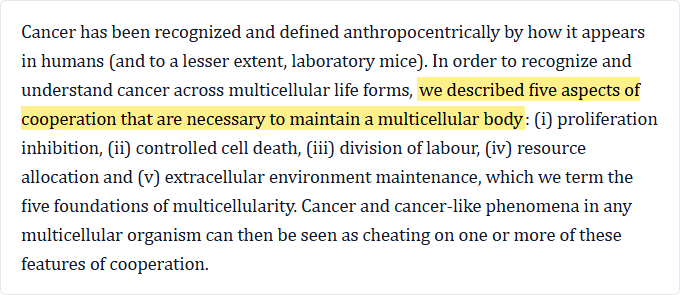
aktipis2015-html-4ae5319b56.png “In order to recognize and understand cancer across multicellular life forms, we described five aspects of cooperation that are necessary to maintain a multicellular body: (i) proliferation inhibition, (ii) controlled cell death, (iii) division of labour, (iv) resource allocation and (v) extracellular environment maintenance, which we term the five foundations of multicellularity.”
- Aktipis CA, Nesse RM (2013). “Evolutionary foundations for cancer biology”. Evolutionary Applications. 6 (1): 144–159. doi:10.1111/eva.12034↩↩2↩3Info
aktipis2013-html-50da1b8899.png “Cancer suppression is as ancient as multicellular life. Multicellular organisms must have mechanisms to suppress cancer effectively.”
- Aktipis CA, Boddy AM, Gatenby RA, Brown JS, Maley CC (2013). “Life history trade-offs in cancer evolution”. Nature Reviews Cancer. 13 (12): 883–892. doi:10.1038/nrc3606↩Info
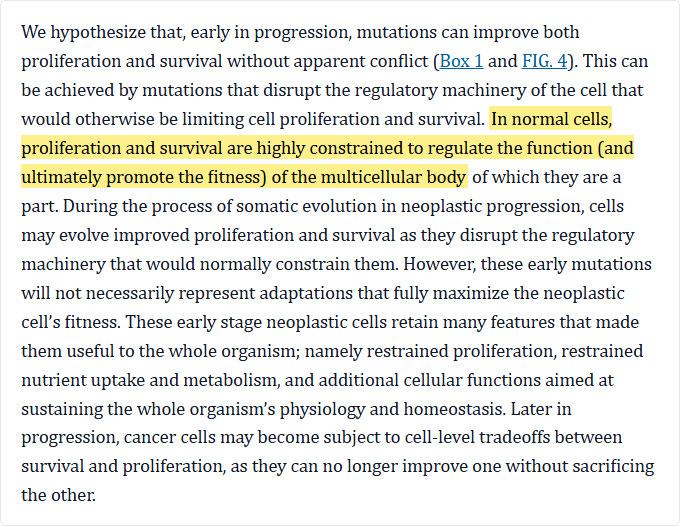
aktipis2013b-html-9b6c5e3d44.png “In normal cells, proliferation and survival are highly constrained to regulate the function (and ultimately promote the fitness) of the multicellular body of which they are a part.”
- Strassmann JE, Queller DC (2011). “Evolution of cooperation and control of cheating in a social microbe”. Proceedings of the National Academy of Sciences. 108 (Suppl 2): 10855–10862. doi:10.1073/pnas.1102451108↩↩2Info
strassmann2011-html-32f1f15011.png “Evolutionary studies of cooperative interactions have focused on the selective advantages of cooperating, how cooperation is organized, whether cheating a cooperative system can occur, and how cheaters are controlled.”
- Axelrod R, Axelrod DE, Pienta KJ (2006). “Evolution of cooperation among tumor cells”. Proceedings of the National Academy of Sciences. 103 (36): 13474–13479. doi:10.1073/pnas.0606053103↩↩2Info
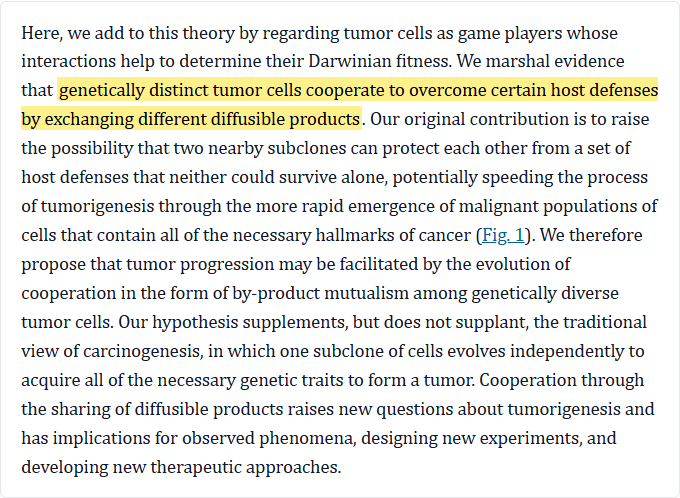
axelrod2006-html-3e06ae294a.png “We marshal evidence that genetically distinct tumor cells cooperate to overcome certain host defenses by exchanging different diffusible products.”
- Archetti M, Ferraro DA, Christofori G (2015). “Heterogeneity for IGF-II production maintained by public goods dynamics in neuroendocrine pancreatic cancer”. Proceedings of the National Academy of Sciences. 112 (6): 1833–1838. doi:10.1073/pnas.1414653112↩↩2Info
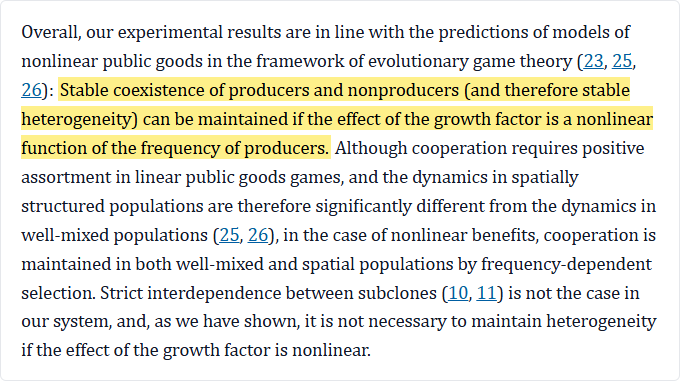
archetti2015-html-839eb901cf.png “Stable coexistence of producers and nonproducers (and therefore stable heterogeneity) can be maintained if the effect of the growth factor is a nonlinear function of the frequency of producers.”