Evolutionary transitions in individuality
Evolutionary transitions in individuality (ETIs) are events in the history of life where previously independent reproducing entities integrate into a new, higher-level evolutionary individual.12 Once a transition stabilizes, natural selection operates primarily on the collective whole rather than independently among its constituent parts.34
Maynard Smith and Szathmáry’s major transitions
John Maynard Smith and Eörs Szathmáry organized biological complexity around eight major transitions unified by two recurring changes: new mechanisms for transmitting hereditary information and mechanisms that suppress internal conflict among parts:1
- Replicating molecules populations of molecules in compartments (containing molecular parasites via stochastic assortment inside dividing protocells).
- Independent replicators chromosomes (linking genes onto shared DNA molecules so replication becomes synchronous).
- RNA as gene and enzyme DNA + protein (the genetic code and division of labor between storage and catalysis).
- Prokaryotes eukaryotes (endosymbiosis integrating archaeal hosts and protomitochondrial symbionts into one cell).
- Asexual clones sexual populations (recombination and meiotic inheritance despite the twofold cost of males).
- Single-celled protists animals, plants, and fungi (obligate multicellularity with somatic division of labor).
- Solitary organisms colonies with non-reproductive castes (eusocial insect superorganisms, such as ants, honeybees, and termites).
- Primate societies human societies with language (symbolic cultural inheritance).
David Queller later grouped these into fraternal transitions (where closely related units stay together, as in clonal multicellularity and eusocial colonies; see Hamilton’s rule) and egalitarian transitions (where unrelated units combine complementary functions without a single-cell bottleneck, as in the eukaryotic cell and its mitochondria).4
Conflict mediation, trade-off curvature, and de-Darwinization
A transition collapses if cheating components replicate faster inside the collective than the collective succeeds between groups. Analyzing the origin of animal multicellularity, Leo Buss proposed that embryonic development evolved specifically to mediate intra-organismal conflict:5
- Single-cell bottleneck. Passing each generation through a single fertilized egg ensures high genetic relatedness across somatic cells (), purging pre-existing within-organism variation so selfish cell lineages must arise anew in each host rather than propagating across generations.5
- Early germline sequestration (Weismann’s barrier). Isolating gametes early denies somatic mutations access to inheritance, restricting mutant lineages to the lifespan of a single host body.54
Richard Michod formalized ETIs as two coupled shifts: conflict mediation (policing internal selfishness) and fitness reorganization (transferring survival and reproduction onto specialized collective parts).23 As colony size increases, the hydrodynamic and energetic cost of reproduction shifts the viability–fecundity trade-off curve from concave to convex, which mathematically selects for cells to specialize completely into either sterile viability-enhancing soma () or reproductive germ ().63
In philosophical terms, Peter Godfrey-Smith’s de-Darwinization framework describes a transition as pushing lower-level parts out of Darwinian space (via bottlenecks , germ lines , and integration ), while Paul Rainey’s ecological scaffolding model shows how patchy resources and dispersal cycles can externally impose collective-level heritability before internal genetic ratchets lock the transition in place.478
Empirical models: volvocine algae and experimental evolution
Two experimental systems allow direct observation of the multicellular transition:
- Volvocine green algae and regA: The volvocine lineage preserves a living gradient spanning unicellular Chlamydomonas, simple 4–16-cell colonies (Gonium, Pandorina), and differentiated Volvox carteri, which pairs ~2,000 sterile flagellated somatic cells with ~16 large reproductive
gonidia.3 Flagellar motility and mitosis conflict mechanically above 32 cells because rigid cell walls prevent basal bodies from serving as mitotic centrioles while attached to beating flagella (the flagellation constraint).3 In Volvox carteri, the master transcriptional regulator regA represses nuclear-encoded chloroplast proteins to keep small somatic cells from growing and dividing—an altruistic program co-opted from an ancestral unicellular stress response.63 When regA mutates, somatic cells redifferentiate into gonidia and proliferate autonomously, forming an algal analog of cancer. - Laboratory evolution and ratcheting: Selecting unicellular yeast (Saccharomyces cerevisiae) for rapid settling evolves branched multicellular “snowflake” clusters across all replicate lines within 60 transfers, followed by single-cell bottlenecks and elevated apoptosis that increases propagule output.9 Accumulating ratcheting mutations that improve group fitness at the expense of single-cell viability subsequently makes reversion to unicellularity evolutionarily unfavorable.7
Relevance to cancer and aging
Because adult vertebrates require continuous tissue renewal and wound repair, somatic cells remain only partially de-Darwinized.4 From the standpoint of ETIs and multilevel selection, cancer is a localized breakdown of the multicellular transition where somatic lineages breach multicellular cooperation and resume cell-level Darwinian evolution (clonal evolution). Maintaining collective individuality across decades therefore requires layered tumor-suppressive constraints—apoptosis, senescence, replicative limits, and non-cell-autonomous tissue policing.
See also
References
Footnotes
- Maynard Smith J, Szathmáry E (1995). The Major Transitions in Evolution. Oxford: W. H. Freeman. ISBN 978-0-19-850294-4. ↩↩2
- Michod RE (1999). Darwinian Dynamics: Evolutionary Transitions in Fitness and Individuality. Princeton, NJ: Princeton University Press. ↩↩2
- Michod RE (2007). “Evolution of individuality during the transition from unicellular to multicellular life”. Proceedings of the National Academy of Sciences. 104 (Suppl 1): 8613–8618. doi:10.1073/pnas.0701489104↩↩2↩3↩4↩5↩6Info
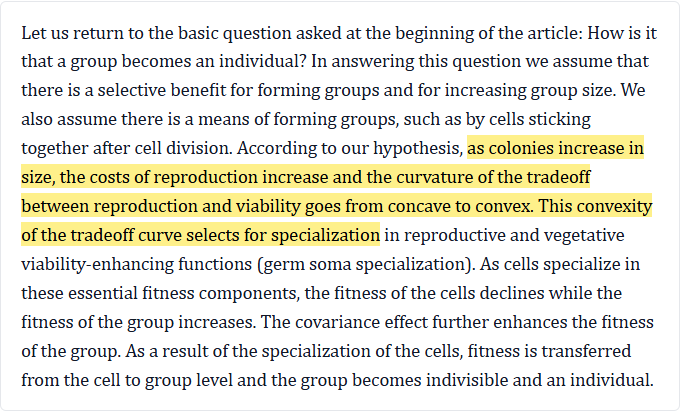
michod2007-html-021184c38f.png “According to our hypothesis, as colonies increase in size, the costs of reproduction increase and the curvature of the tradeoff between reproduction and viability goes from concave to convex. This convexity of the tradeoff curve selects for specialization in reproductive and vegetative viability-enhancing functions (germ soma specialization). As cells specialize in these essential fitness components, the fitness of the cells declines while the fitness of the group increases.”
- Godfrey-Smith P (2009). Darwinian Populations and Natural Selection. Oxford: Oxford University Press. ISBN 978-0-19-955204-7.↩↩2↩3↩4↩5Info

godfreysmith2009-p112-b5-cf22fc4762.png “Many biologists think the eukaryotic cell evolved from a collaborative union of several prokaryotic cells… Notice that this transition has a different signature from the two others above; it does not use a narrow bottleneck across generations, corresponding to the one-celled stage in multicellular organisms or the lone queen founding a nest.”
- Buss LW (1987). The Evolution of Individuality. Princeton, NJ: Princeton University Press. ↩↩2↩3
- Michod RE, Viossat Y, Solari CA, Hurand M, Nedelcu AM (2006). “Life-history evolution and the origin of multicellularity”. Journal of Theoretical Biology. 239 (2): 257–272. doi:10.1016/j.jtbi.2005.08.043↩↩2
- Libby E, Conlin PL, Kerr B, Ratcliff WC (2016). “Stabilizing multicellularity through ratcheting”. Philosophical Transactions of the Royal Society B. 371 (1701): 20150444. doi:10.1098/rstb.2015.0444↩↩2Info
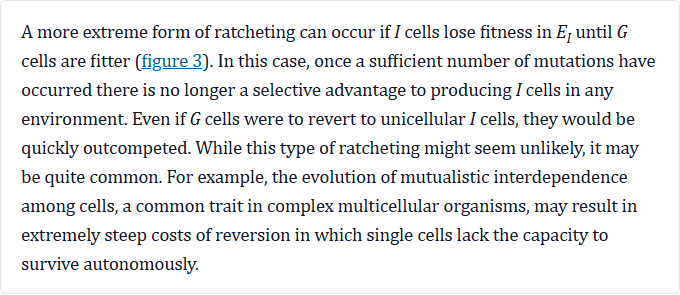
libby2016-html-5f9050244f.png “once a sufficient number of mutations have occurred there is no longer a selective advantage to producing I cells in any environment. Even if G cells were to revert to unicellular I cells, they would be quickly outcompeted.”
- Rainey PB (2023). “Major evolutionary transitions in individuality between humans and AI”. Philosophical Transactions of the Royal Society B. 378 (1872): 20210408. doi:10.1098/rstb.2021.0408↩Info
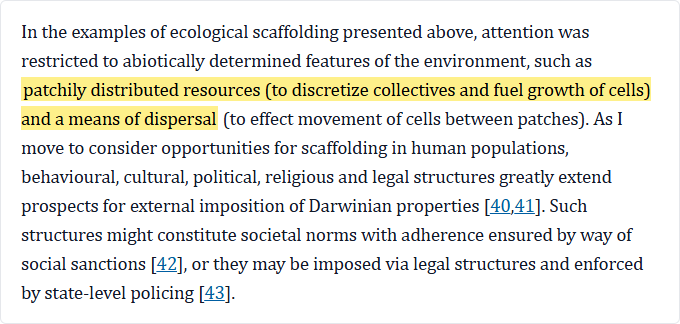
rainey2023-html-70310f9986.png “In the examples of ecological scaffolding presented above, attention was restricted to abiotically determined features of the environment, such as patchily distributed resources (to discretize collectives and fuel growth of cells) and a means of dispersal (to effect movement of cells between patches).”
- Ratcliff WC, Denison RF, Borrello M, Travisano M (2012). “Experimental evolution of multicellularity”. Proceedings of the National Academy of Sciences. 109 (5): 1595–1600. doi:10.1073/pnas.1115323109↩Info
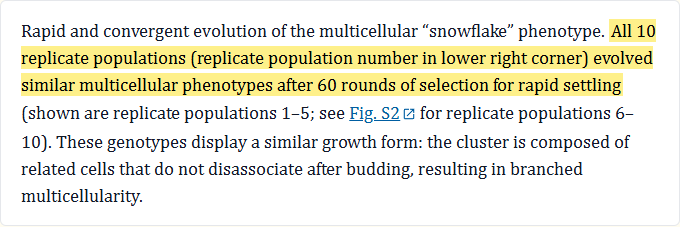
ratcliff2012-html-8fbe075ea5.png “All 10 replicate populations (replicate population number in lower right corner) evolved similar multicellular phenotypes after 60 rounds of selection for rapid settling… the cluster is composed of related cells that do not disassociate after budding, resulting in branched multicellularity.”