De-Darwinization
De-Darwinization suppresses Darwinian evolution among lower-level parts so that a collective can emerge as a higher-level unit of selection. For a body or colony to act as an evolutionary individual, its cells or workers cannot evolve freely at the group’s expense.1
Philosopher Peter Godfrey-Smith coined the term within the evolutionary transitions in individuality framework of John Maynard Smith and Eörs Szathmáry. In multicellular organisms, de-Darwinization acts as a partial, ongoing constraint. Single-cell bottlenecks and germline sequestration channel lower-level selection while somatic mutation and clonal competition continue inside healthy tissues.23
Godfrey-Smith’s parameter mechanics: how , , and reshape Darwinian space
Godfrey-Smith maps populations in a “Darwinian space” using five parameters: fidelity of heredity (), abundance of variation (), dependence of realized fitness on intrinsic character (), smoothness of the fitness landscape (), and intensity of competitive interaction ().1 As a collective moves toward the paradigm corner of this space, it pulls its constituent parts away from that corner. Joeri Witteveen summarized this reciprocity as: “Darwinization at higher level and de-Darwinization at the lower level go together.”4
The three collective-level reproduction parameters, bottleneck (), germ line (), and integration (), suppress lower-level evolution through distinct mechanisms. Their effects also depend on perspective: whether you treat each collective as a separate short-lived arena, or track the total lower-level population distributed across all collectives.5
- Bottlenecks () constrain within-organism and package , but cannot stop cross-generational subversion alone. Starting each organism from a single cell restricts the initial variation () inside each body, with absolute founding cell count doing the de-Darwinizing work. Across the metapopulation of cells, sealed bottlenecks also reorganize competitive interaction (). Intense interactions occur among genetically similar cells inside one body, while genetically different cells sit in separate bodies and rarely meet. Yet a bottleneck reduces only the scope of within-organism evolution, not its cross-generational consequences. If a lottery chose adult cells as propagules, whichever cell lineage won within-organism competition would still seed the next generation of organisms.1
- Germ-line sequestration () drives down cellular (high at level low at level ). Early sequestration of a germ line disconnects long-term lineage survival from a cell’s competitive traits and ties it to relational location (residing in the germ line). Cellular heredity () remains high, and short-term within-organism Darwinian processes still occur: Godfrey-Smith cites both adaptive immunity and cancer. Those somatic lineages hit an evolutionary dead end, pulling the cellular population away from the paradigm region along .5
- Integration () and three distinct evolutionary paths. Physiological interdependence and policing align cell-level fates with the collective. De-Darwinization has followed at least three distinct evolutionary routes: fraternal transitions via bottlenecks and germ lines in multicellularity, colony-level reproductive division of labor in eusocial insects, and egalitarian transitions without a bottleneck where one partner engulfs and controls the other’s reproduction, as in the eukaryotic cell and its mitochondria.6
The “post-populational” limit
De-Darwinization can proceed so far that lower-level entities lose their own reproductive machinery and stop forming a Darwinian population altogether, becoming “post-populational.” Real biological systems fall along a gradient. Mitochondria (which surrendered essential parts of their reproductive machinery) and enucleated mammalian red blood cells sit near the post-populational extreme. Human somatic cells with nuclei have lost ancestral autonomy, yet they keep their cell boundaries and division machinery, making them “not (or not yet) ‘post-populational.’” Modular organisms such as corals and trees retain even more population-like dynamics among their cells.6
Empirical tests and evolutionary ratcheting
Experimental evolution and theoretical modeling test how rapidly collectives acquire de-Darwinizing traits and how those transitions resist reversion:
- Uniclonal clusters and division of labor. Subjecting unicellular Saccharomyces cerevisiae to settling selection rapidly produced uniclonal “snowflake” clusters that reproduce via propagules and minimize within-cluster genetic conflict. These clusters subsequently evolved higher rates of programmed cell death (apoptosis) as an early reproductive division of labor.7
- Contingent ecological origins. Exposing outcrossed populations of the unicellular green alga Chlamydomonas reinhardtii to predation by Paramecium tetraurelia drove de novo origins of heritable multicellular life cycles in two of five experimental populations within ~750 asexual generations. Ecological pressures can trigger multicellularity while leaving life-cycle details (cell number and propagule size) evolutionarily contingent.8
- Evolutionary ratcheting. Simple multicellular clusters can still revert to unicellularity when environments fluctuate. Modeling by Libby and colleagues identifies two reinforcing classes of ratcheting mutations: mutations beneficial in a multicellular context that impose heavy fitness costs on unicellular revertants, and mutations that directly lower the probability of reversion.9
Applications across biological and technological scales
Multicellularity and eusociality
In multicellularity, Leo Buss and Richard Michod framed individuality as fitness transfer from cells to the organism via conflict suppression. Degrees of de-Darwinization vary sharply across lineages: human somatic cells are far more tightly constrained than the nuclei sharing a multinucleate fungal mycelium.10 In eusocial insects such as ants and honeybees, sterile worker castes play the analogous role to somatic cells, while reproductive queens act as a colony-level germline.4
Cancer as re-Darwinization
In evolutionary oncology, cancer represents a localized breakdown of somatic de-Darwinization, termed re-Darwinization, where mutant cells escape tissue constraints and evolve within the host at the organism’s expense.11 Somatic selection also operates continuously in healthy tissues to clear damaged cells via apoptosis and cell competition. Within-body selection therefore acts both to suppress and to promote cancer depending on the balance across levels.11
Human–AI symbiosis (speculative)
Paul B. Rainey has extended evolutionary transitions in individuality to human–AI collectives. He argues that cultural and technological structures can act as external ecological scaffolds imposing heritable fitness variance at the composite human–AI level, potentially driving co-dependency and partial de-Darwinization of individual humans if replicative fates align.12
Somatic evolution in healthy tissues
Deep sequencing of physiologically normal human tissues reveals active somatic selection throughout adult life:
- Pervasive positive selection in healthy tissue. Mapping mutant cells in healthy esophageal epithelium from human donors aged 20–75 revealed strong positive selection across 14 canonical cancer genes. In middle-aged and elderly donors, NOTCH1 mutations colonized 12–80% of cells and TP53 mutations colonized 2–37%, with NOTCH1 prevalence several times higher in normal esophagus than in esophageal cancers.3
- Concordant somatic selection. Adaptive immunity (clonal selection of lymphocytes) and widespread somatic mosaicism across neurons, epithelia, epidermis, and hematopoietic stem cells show ongoing somatic evolution across adult organs (see Clonal governance).2
See also
- Evolutionary transitions in individuality
- Germline sequestration (Weismann barrier)
- Multilevel selection
- Clonal governance
- Clonal evolution
- Multicellular cooperation
References
Footnotes
- Godfrey-Smith P (2009). Darwinian Populations and Natural Selection. Oxford: Oxford University Press, pp. 100–102 (Section 5.3, “De-Darwinization”).↩↩2↩3Info
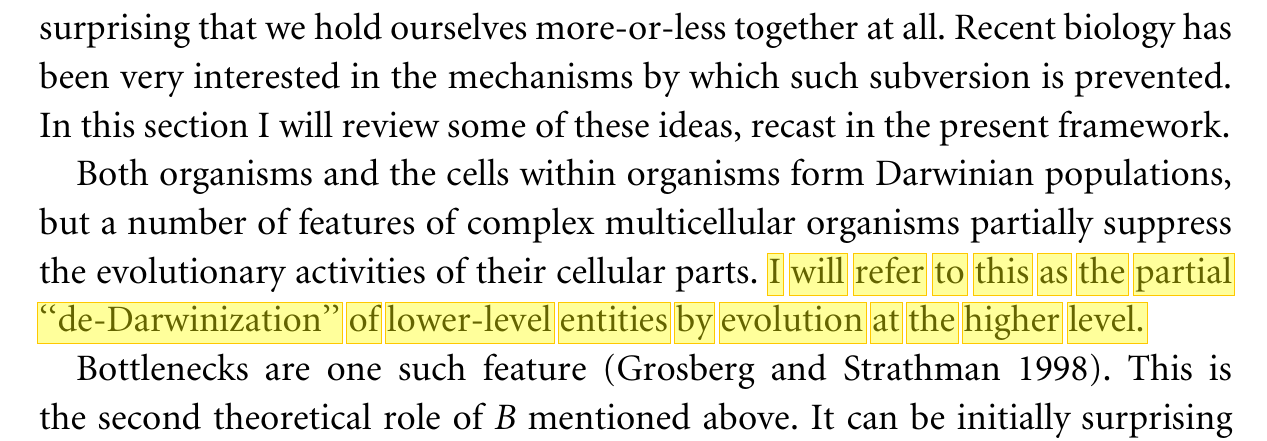
godfreysmith2009-book-p2-b4-789d9023ae.png “Both organisms and the cells within organisms form Darwinian populations, but a number of features of complex multicellular organisms partially suppress the evolutionary activities of their cellular parts. I will refer to this as the partial ‘de-Darwinization’ of lower-level entities by evolution at the higher level.”
- Świątczak B (2021). “Struggle within: evolution and ecology of somatic cell populations”. Cellular and Molecular Life Sciences. 78 (21–22): 6797–6806. doi:10.1007/s00018-021-03931-6↩↩2Info
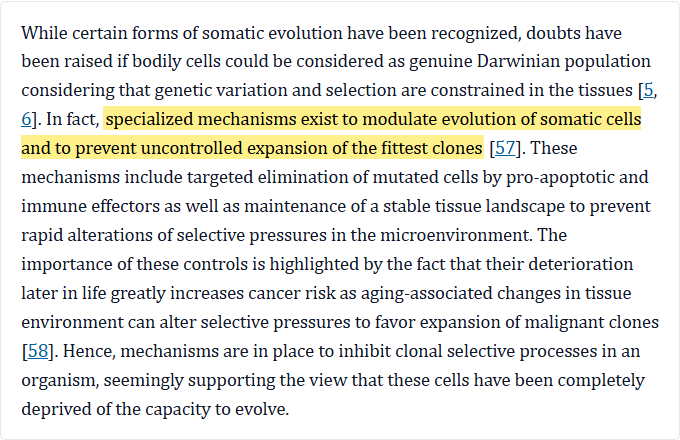
swiatczak2021-html-4b6e1db889.png “In fact, specialized mechanisms exist to modulate evolution of somatic cells and to prevent uncontrolled expansion of the fittest clones [57]. These mechanisms include targeted elimination of mutated cells by pro-apoptotic and immune effectors as well as maintenance of a stable tissue landscape to prevent rapid alterations of selective pressures in the microenvironment.”
- Martincorena I, Fowler JC, Wabik A, Lawson ARJ, Abascal F, et al. (2018). “Somatic mutant clones colonize the human esophagus with age”. Science. 362 (6417): 911–917. doi:10.1126/science.aau3879↩↩2Info
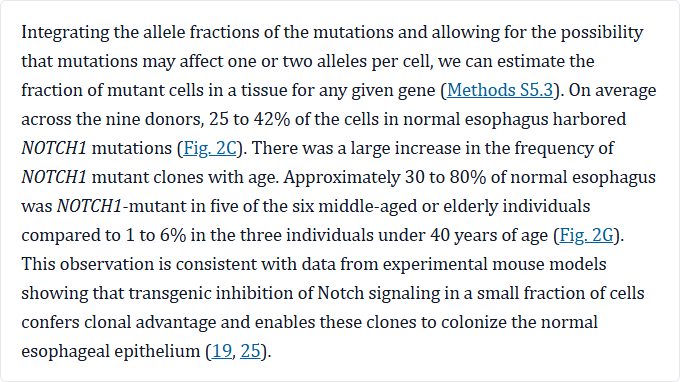
martincorena2018-html-56f8cba623.png “Approximately 30 to 80% of normal esophagus was NOTCH1-mutant in five of the six middle-aged or elderly individuals compared to 1 to 6% in the three individuals under 40 years of age (Fig. 2G).”
- Witteveen J (2009). “Darwinism about Darwinism: Review of Darwinian Populations and Natural Selection by Peter Godfrey-Smith”. Biological Theory. 4 (2): 207–213.↩↩2Info
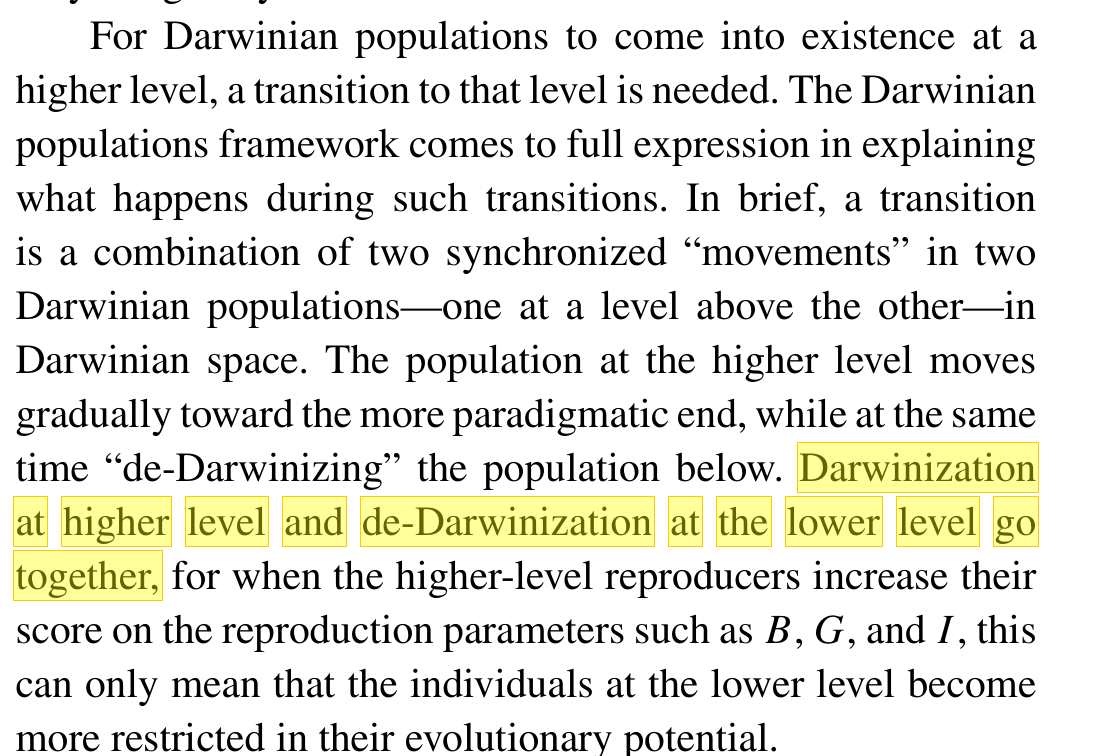
godfrey-smith2009-p3-b6-79b02e76eb.png “The population at the higher level moves gradually toward the more paradigmatic end, while at the same time ‘de-Darwinizing’ the population below. Darwinization at higher level and de-Darwinization at the lower level go together, for when the higher-level reproducers increase their score on the reproduction parameters such as B, G, and I, this can only mean that the individuals at the lower level become more restricted in their evolutionary potential.”
- Godfrey-Smith P (2009). Darwinian Populations and Natural Selection. Oxford: Oxford University Press, pp. 102–103, 124–125 (coupling of collective to lower-level , and to and ).↩↩2Info
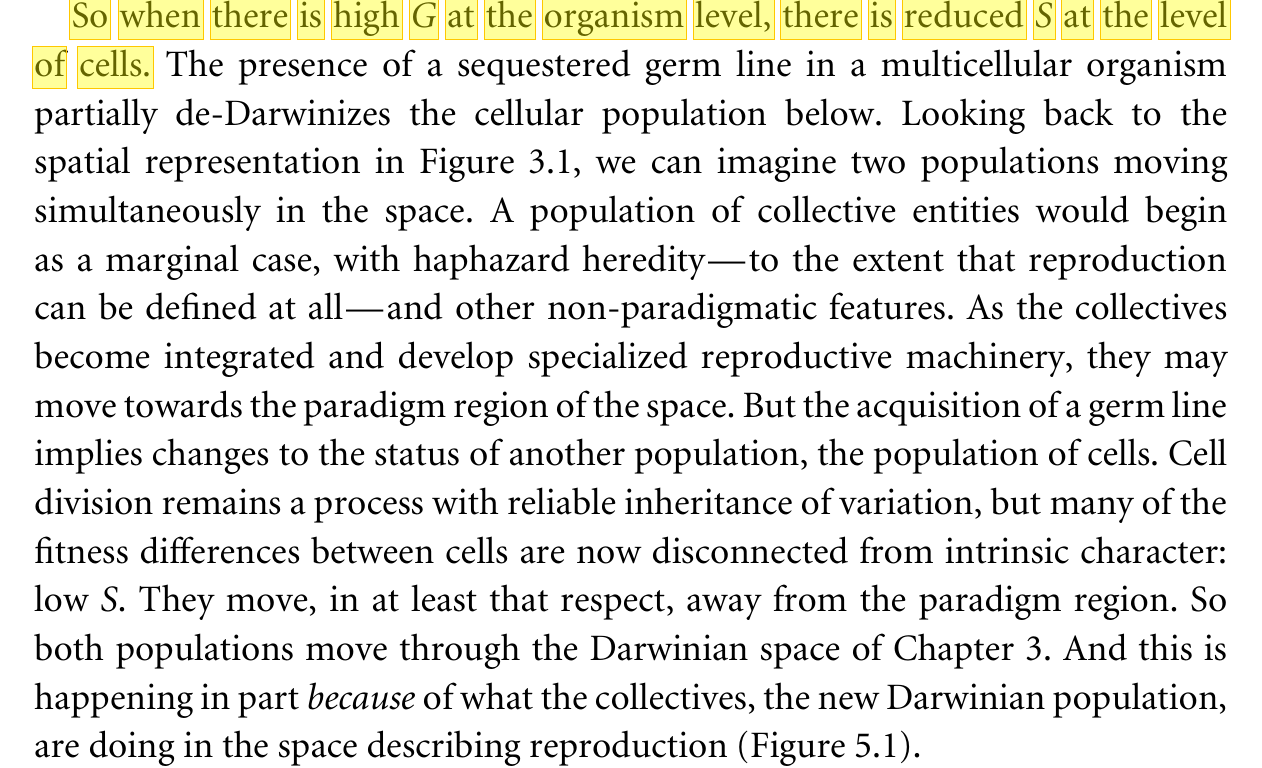
godfreysmith2009-book-p4-b2-7479dba853.png “So when there is high G at the organism level, there is reduced S at the level of cells. The presence of a sequestered germ line in a multicellular organism partially de-Darwinizes the cellular population below… Cell division remains a process with reliable inheritance of variation, but many of the fitness differences between cells are now disconnected from intrinsic character: low S.”
- Godfrey-Smith P (2009). Darwinian Populations and Natural Selection. Oxford: Oxford University Press, pp. 122–126 (Chapter 6, three paths to de-Darwinization and the “post-populational” limit).↩↩2Info
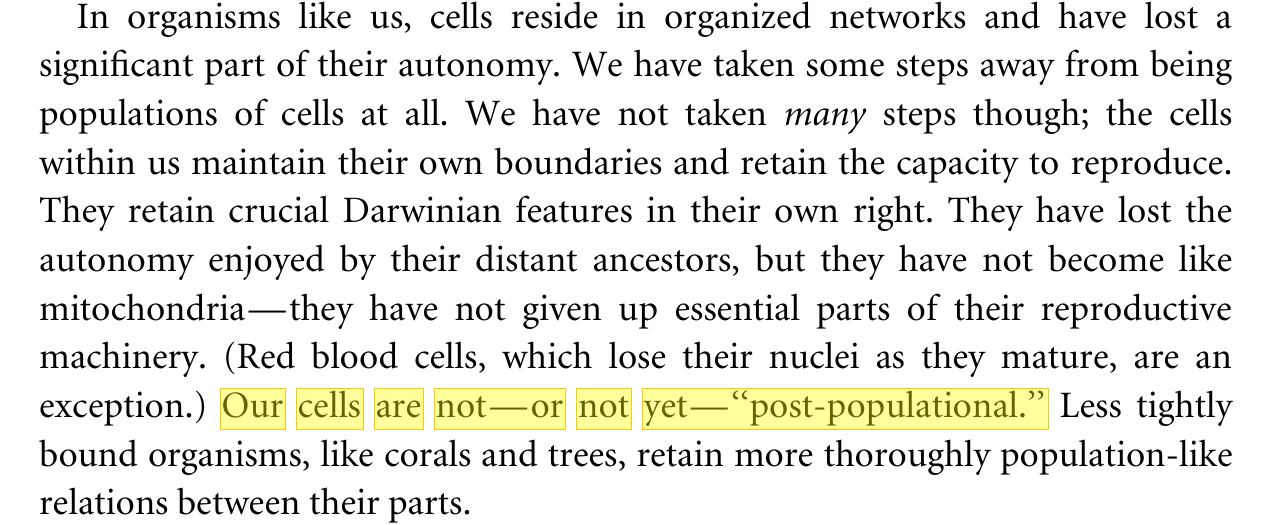
godfreysmith2009-ch6-p6-b3-7e3ea6fbc8.png “They have lost the autonomy enjoyed by their distant ancestors, but they have not become like mitochondria—they have not given up essential parts of their reproductive machinery. (Red blood cells, which lose their nuclei as they mature, are an exception.) Our cells are not—or not yet—‘post-populational.’ Less tightly bound organisms, like corals and trees, retain more thoroughly population-like relations between their parts.”
- Ratcliff WC, Denison RF, Borrello M, Travisano M (2012). “Experimental evolution of multicellularity”. Proceedings of the National Academy of Sciences. 109 (5): 1595–1600. doi:10.1073/pnas.1115323109↩Info
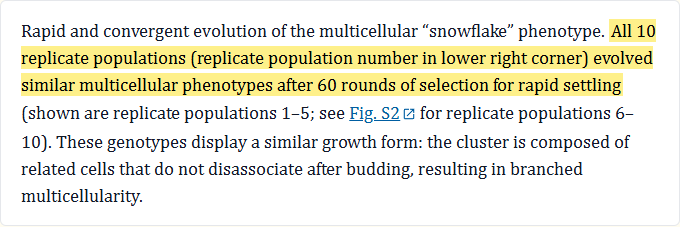
ratcliff2012-html-8fbe075ea5.png “All 10 replicate populations (replicate population number in lower right corner) evolved similar multicellular phenotypes after 60 rounds of selection for rapid settling… the cluster is composed of related cells that do not disassociate after budding, resulting in branched multicellularity.”
- Herron MD, Borin JM, Boswell JC, Walker J, Chen ICK, et al. (2019). “De novo origins of multicellularity in response to predation”. Scientific Reports. 9: 2328. doi:10.1038/s41598-019-39558-8↩Info
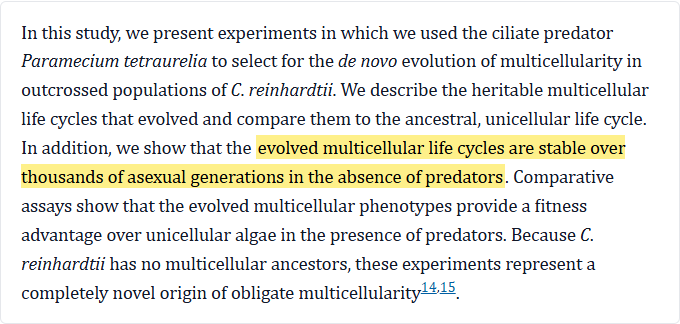
herron2019-html-7255501eb7.png “In addition, we show that the evolved multicellular life cycles are stable over thousands of asexual generations in the absence of predators. Comparative assays show that the evolved multicellular phenotypes provide a fitness advantage over unicellular algae in the presence of predators.”
- Libby E, Conlin PL, Kerr B, Ratcliff WC (2016). “Stabilizing multicellularity through ratcheting”. Philosophical Transactions of the Royal Society B. 371 (1701): 20150444. doi:10.1098/rstb.2015.0444↩Info
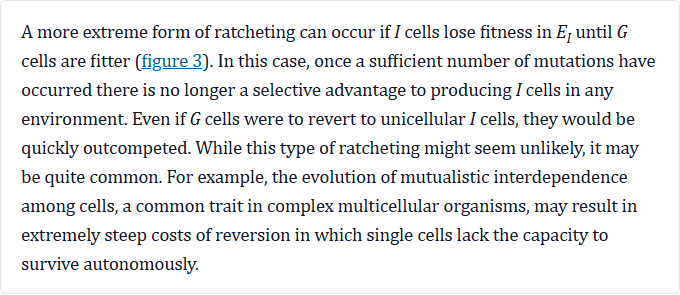
libby2016-html-5f9050244f.png “once a sufficient number of mutations have occurred there is no longer a selective advantage to producing I cells in any environment. Even if G cells were to revert to unicellular I cells, they would be quickly outcompeted.”
- Booth AG (2014). Essays on Biological Individuality (PhD thesis). Cambridge, MA: Harvard University. ↩
- Bertolaso M, Dieli AM (2017). “Cancer and intercellular cooperation”. Royal Society Open Science. 4 (10): 170470. doi:10.1098/rsos.170470↩↩2Info
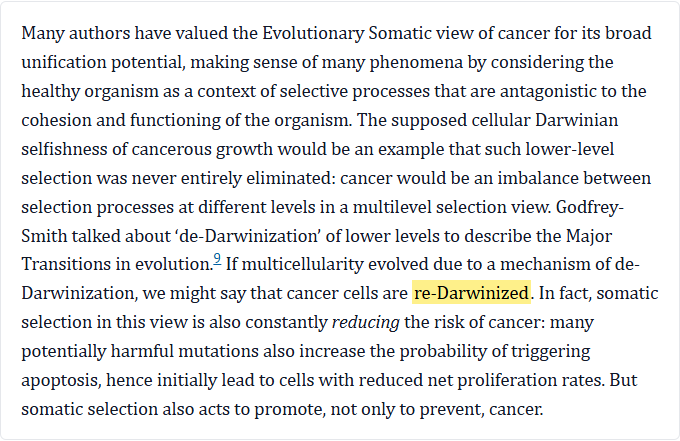
bertolaso2017-html-66dc6ce796.png “If multicellularity evolved due to a mechanism of de-Darwinization, we might say that cancer cells are re-Darwinized. In fact, somatic selection in this view is also constantly reducing the risk of cancer: many potentially harmful mutations also increase the probability of triggering apoptosis, hence initially lead to cells with reduced net proliferation rates. But somatic selection also acts to promote, not only to prevent, cancer.”
- Rainey PB (2023). “Major evolutionary transitions in individuality between humans and AI”. Philosophical Transactions of the Royal Society B. 378 (1872): 20210408. doi:10.1098/rstb.2021.0408↩Info
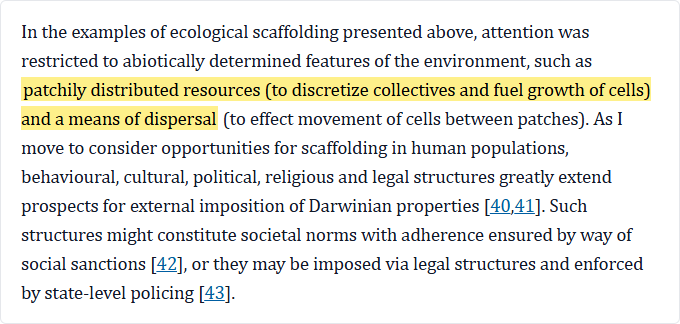
rainey2023-html-70310f9986.png “In the examples of ecological scaffolding presented above, attention was restricted to abiotically determined features of the environment, such as patchily distributed resources (to discretize collectives and fuel growth of cells) and a means of dispersal (to effect movement of cells between patches).”