Flower (Drosophila)
For the human orthologue in cancer supercompetition, see CACFD1.
Flower (fwe, CG6151) is a Drosophila melanogaster transmembrane protein whose splice isoforms create an extracellular fitness code during cell competition.12 Its conserved pore domain also conducts across synaptic vesicles.1 Neighboring cells in developing fly epithelia and brain compare surface Flower isoforms to decide whether a weaker cell survives or dies via Azot and apoptosis.23
Dual function: synaptic channel and surface fitness code
First cloned in Drosophila by Yao and colleagues (2009) as a four-pass transmembrane protein concentrated on synaptic vesicles, Flower forms multimerized -conducting channels via an acidic pore residue (E79) required for clathrin-mediated synaptic-vesicle endocytosis at neuromuscular junctions and photoreceptors.1
In 2010, Rhiner and colleagues discovered that the flower locus also generates three alternative splice isoforms that differ at their extracellular C-terminal tail and broadcast relative cellular fitness across epithelial boundaries:2
- Flower^ubi (ubiquitous / winner): Expressed constitutively on healthy wing-disc epithelial cells, and rapidly downregulated when a cell suffers a relative drop in metabolic or translational fitness.
- Flower^Lose-A and Flower^Lose-B (loser tags): Induced specifically on cells with lower relative fitness—such as ribosomal Minute/+ mutants, wild-type cells bordered by dMyc-overexpressing supercompetitors, or sub-optimal neurons during retinal patterning.23
Displaying Flower^Lose does not kill a cell in isolation. Elimination is strictly relational: a cell expressing Flower^Lose-A or Flower^Lose-B undergoes apoptosis only when contacted by fitter neighbors that lack Flower^Lose and express Flower^ubi.2 If every cell in a tissue patch expresses Flower^Lose, no competition-induced apoptosis occurs.
The Drosophila Azot (ahuizotl) fitness checkpoint and lifespan extension
Downstream of Flower^Lose display, Drosophila cells pass through a dedicated four-EF-hand cytoplasmic calcium-binding gatekeeper encoded by azot (ahuizotl, named after the Aztec mythological creature that culled weak fishermen):3
- Dedicated loser-elimination gate:Azot transcription switches on specifically in Flower^Lose-positive cells that fail the relative fitness comparison against neighbors (integrating Flower^Lose with Secreted Wingless-interacting molecule, Swim, and Decapentaplegic/Dpp signaling).3
- Direct induction of hid apoptosis: Azot protein is both necessary and sufficient to activate transcription of the pro-apoptotic gene hid, committing the loser cell to caspase execution.3
- Organismal anti-aging effect: Deleting azot blocks Flower^Lose-mediated cell competition, causes accumulation of developmentally malformed wings, neurodegeneration vacuoles, and accelerated aging, and shortens fly lifespan. Conversely, introducing one extra genomic copy of azot (three functional copies total) sharpens elimination of sub-optimal cells across adult tissues and extends Drosophila median lifespan by 54–66%.3
Human orthologue: CACFD1
In vertebrates, the flower orthologue is CACFD1 (calcium channel flower domain containing 1, human chromosome 9q34.13, UniProt Q9UGQ2).4 Although mammals lack an azot orthologue, human CACFD1 conserves the four-isoform winner/loser splice code (hFWE2/4 winner vs. hFWE1/3 loser isoforms) and is co-opted by malignant human tumors to induce caspase-dependent apoptosis in surrounding host stroma.4
See also
- CACFD1 — human orthologue (
Q9UGQ2) and tumor–stroma supercompetition - Cell competition
- Non-cell-autonomous tumor suppression
- Multicellular cooperation
- De-Darwinization
References
Footnotes
- Yao CK, Lin YQ, Ly CV, Ohyama T, Haueter CM, Moiseenkova-Bell VY, Wensel TG, Bellen HJ (2009). “A synaptic vesicle-associated Ca2+ channel promotes endocytosis and couples exocytosis to endocytosis”. Cell. 138 (5): 947–960. doi:10.1016/j.cell.2009.08.033↩↩2↩3
- Rhiner C, López-Gay JM, Soldini D, Casas-Tinto S, Martín FA, Lombardia L, Moreno E (2010). “Flower forms an extracellular code that reveals the fitness of a cell to its neighbors in Drosophila”. Developmental Cell. 18 (6): 985–998. doi:10.1016/j.devcel.2010.05.010↩↩2↩3↩4↩5
- Merino MM, Rhiner C, Lopez-Gay JM, Buechel D, Hauert B, Moreno E (2015). “Elimination of unfit cells maintains tissue health and prolongs lifespan”. Cell. 160 (3): 461–476. doi:10.1016/j.cell.2014.12.017↩↩2↩3↩4↩5↩6Info
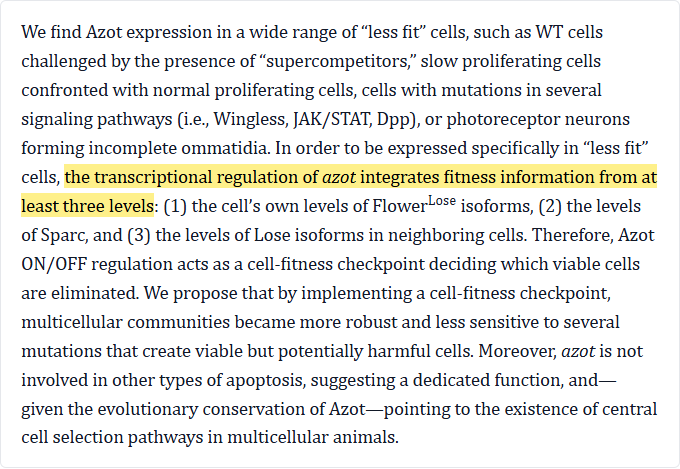
merino2015-html-4cbdd3fea7.png “In order to be expressed specifically in “less fit” cells, the transcriptional regulation of azot integrates fitness information from at least three levels: (1) the cell’s own levels of FlowerLose isoforms, (2) the levels of Sparc, and (3) the levels of Lose isoforms in neighboring cells. Therefore, Azot ON/OFF regulation acts as a cell-fitness checkpoint deciding which viable cells are eliminated.”
- Madan E, Pelham CJ, Nagane M, Parker TM, Canas-Marques R, et al. (2019). “Flower isoforms promote competitive growth in cancer”. Nature. 572 (7768): 260–264. doi:10.1038/s41586-019-1429-3↩↩2Info
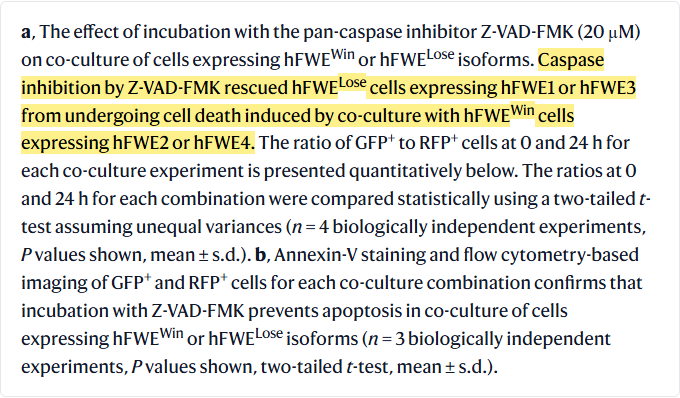
madan2019-html-ec1136bf94.png “Caspase inhibition by Z-VAD-FMK rescued hFWELose cells expressing hFWE1 or hFWE3 from undergoing cell death induced by co-culture with hFWEWin cells expressing hFWE2 or hFWE4.”