Senescence-associated secretory phenotype (SASP)
The senescence-associated secretory phenotype (SASP) is the collection of signaling proteins and proteases that senescent cells secrete into surrounding tissue.1 The program develops over several days after a cell enters stable division arrest.12 Early SASP signals reinforce senescence and recruit immune cells to clear damaged cells. Chronic SASP signaling, however, drives sterile inflammation and promotes invasion in neighboring premalignant cells.12
Composition
Jean-Philippe Coppé, Judith Campisi, and colleagues defined and profiled the SASP in 2008 using quantitative antibody arrays across senescent human fibroblasts and epithelial cells.1 The inflammatory cytokines interleukin-6 (IL-6) and interleukin-8 (IL-8/CXCL8) carry much of the paracrine activity, accompanied by IL-1/, GRO (CXCL1), MCP-1 (CCL2), IGF-binding proteins, vascular endothelial growth factor (VEGF), urokinase/PAI-1, and matrix metalloproteinases (especially MMP-1 and MMP-3).12
Kinetics and innate DNA-sensing triggers (cGAS–STING)
Unlike an acute DNA-damage stress response, the SASP develops slowly over 4–7 days and requires genotoxic stress severe enough to induce permanent arrest.1 Fibroblasts, normal epithelial cells, and prostate tumor cells sampled from patients after DNA-damaging chemotherapy all express similar SASP profiles in vivo.1
At the molecular level, the inflammatory branch of the SASP is driven by NF-B (p65/RelA) and C/EBP, reinforced at the cell surface by an autocrine IL-1 loop and unlocked upstream by cytoplasmic DNA sensing:23
- Cytoplasmic chromatin fragments (CCFs) and cGAS–STING: Loss of nuclear lamina integrity (Lamin B1 decline) in senescent cells allows damaged chromatin blebs to bud into the cytoplasm as CCFs.3 The cytosolic DNA sensor cGAS recognizes CCFs and synthesizes cGAMP to activate STING, which triggers NF-B p65 phosphorylation and nuclear translocation to transcribe inflammatory SASP genes.3
- Separability of arrest from secretion: Suppressing cGAS or STING abolishes NF-B activation and SASP cytokine release without reversing ATM, p53, , or heterochromatin cell-cycle arrest—demonstrating that senescent growth arrest and inflammatory secretion are governed by separable molecular circuits.3
Regulation by p53 and oncogenic RAS
Two cancer-relevant pathways sharply modulate SASP amplitude. Expressing oncogenic RAS or inactivating p53 each accelerates and amplifies SASP secretion several-fold, worsening its pro-malignant paracrine effects on neighboring cells.1 Thus p53 acts not only as a cell-autonomous cell-cycle brake, but also as a non-cell-autonomous tumor suppressor that restrains runaway inflammatory secretion from damaged cells.1
Dual function: immune clearance versus tumor promotion
The SASP exports the senescence program beyond the arrested cell into the surrounding tissue ecosystem (cancer ecology):
- Autocrine reinforcement and immune surveillance: Early SASP chemokines and cytokines reinforce the senescent arrest (via CXCR2 and IL-6R), promote wound healing and fibrosis resolution, and recruit macrophages, NK cells, and T cells to clear senescent cells.2
- Paracrine tumor promotion (“the dark side of tumor suppression”): When senescent fibroblasts persist next to premalignant epithelial cells, secreted IL-6, IL-8, and MMP-3 disrupt epithelial cluster differentiation, trigger an epithelial-to-mesenchymal transition (EMT), and stimulate basement-membrane invasion.12
Role in aging and senomorphic therapy
When senescent cells persist in aged tissues, chronic SASP release supplies a sterile inflammatory signal (inflammaging). Because the division arrest itself is tumor-suppressive while chronic SASP secretion damages tissue architecture, senomorphic drugs (such as JAK1/2, mTOR, NF-B, or cGAS–STING inhibitors) aim to silence the SASP while leaving the cell-cycle arrest intact, whereas senolytics attempt to kill the senescent cells outright (see Cellular senescence and Types of cell senescence and quiescence).3
See also
- Cellular senescence
- Senolytics
- Types of cell senescence and quiescence
- IL-6 and IL-8 (CXCL8)
- p53
- Judith Campisi
References
Footnotes
- Coppé JP, Patil CK, Rodier F, Sun Y, Muñoz DP, Goldstein J, Nelson PS, Desprez PY, Campisi J (2008). “Senescence-associated secretory phenotypes reveal cell-nonautonomous functions of oncogenic RAS and the p53 tumor suppressor”. PLoS Biology. 6 (12): 2853–2868. doi:10.1371/journal.pbio.0060301↩↩2↩3↩4↩5↩6↩7↩8↩9↩10Info
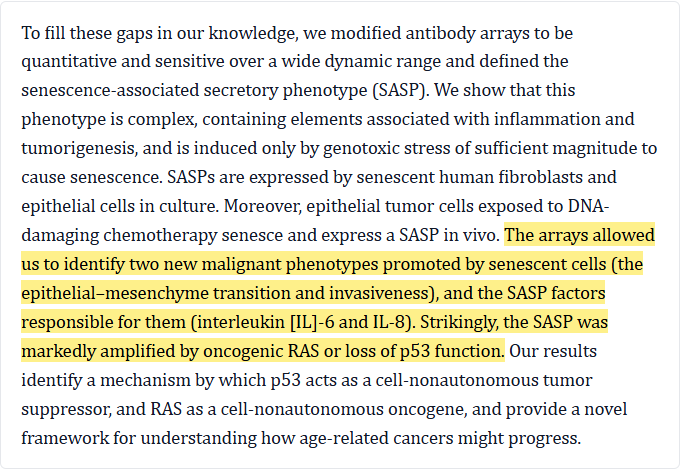
coppe2008-html-b6e83db63f.png “The arrays allowed us to identify two new malignant phenotypes promoted by senescent cells (the epithelial–mesenchyme transition and invasiveness), and the SASP factors responsible for them (interleukin [IL]-6 and IL-8). Strikingly, the SASP was markedly amplified by oncogenic RAS or loss of p53 function. Our results identify a mechanism by which p53 acts as a cell-nonautonomous tumor suppressor, and RAS as a cell-nonautonomous oncogene.”
- Coppé JP, Desprez PY, Krtolica A, Campisi J (2010). “The senescence-associated secretory phenotype: the dark side of tumor suppression”. Annual Review of Pathology. 5: 99–118. doi:10.1146/annurev-pathol-121808-102144↩↩2↩3↩4↩5↩6Info
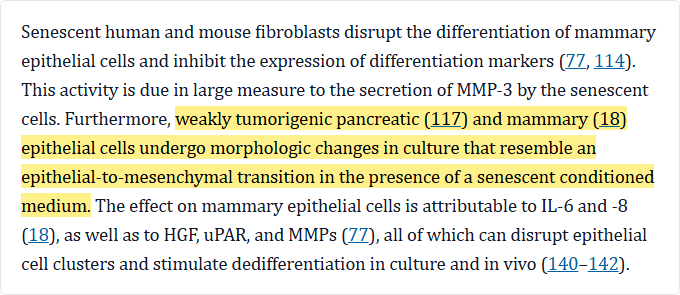
coppe2010-html-aaa9439902.png “Senescent human and mouse fibroblasts disrupt the differentiation of mammary epithelial cells and inhibit the expression of differentiation markers (77, 114). This activity is due in large measure to the secretion of MMP-3 by the senescent cells. Furthermore, weakly tumorigenic pancreatic (117) and mammary (18) epithelial cells undergo morphologic changes in culture that resemble an epithelial-to-mesenchymal transition in the presence of a senescent conditioned medium. The effect on mammary epithelial cells is attributable to IL-6 and -8.”
- Dou Z, Ghosh K, Vizioli MG, Zhu J, Sen P, Wangensteen KJ, Simithy J, Lan Y, Lin Y, Zhou Z, Capell BC, Xu C, Xu M, Kieckhaefer JE, Jiang T, Shoshkes-Carmel M, Tanim KMAA, Barber GN, Seykora JT,ydoroski SE, Adams PD, Garcia BA, Berger SL (2017). “Cytoplasmic chromatin triggers inflammation in senescence and cancer”. Nature. 550 (7676): 402–406. doi:10.1038/nature24050↩↩2↩3↩4↩5Info
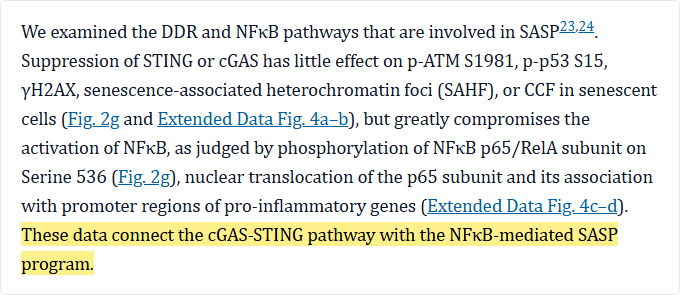
dou2017-html-ff72e6cf27.png “Suppression of STING or cGAS has little effect on p-ATM S1981, p-p53 S15, γH2AX, senescence-associated heterochromatin foci (SAHF), or CCF in senescent cells (Fig. 2g and Extended Data Fig. 4a–b), but greatly compromises the activation of NFκB… These data connect the cGAS-STING pathway with the NFκB-mediated SASP program.”