Hamilton’s rule
Hamilton’s rule () predicts when natural selection promotes costly cooperation or altruism among relatives.12 An allele for altruism increases in frequency when the recipient’s reproductive gain (), multiplied by genetic relatedness (), exceeds the actor’s reproductive loss ().12 Derived by W. D. Hamilton in 1963 and 1964, this inequality provides the core equation of kin selection and inclusive fitness theory.12
The inequality and inclusive fitness
When an actor’s social behavior changes its own direct offspring count by and a partner’s offspring count by , its inclusive fitness changes by:12
- (coefficient of relatedness): Regression of the recipient’s genotype at the social locus on the actor’s genotype, measured above the population mean.13 In an outbred diploid population: for clones or identical twins, for full siblings or parent–offspring, for half-siblings or grandchildren, and for first cousins.
- (benefit to recipient): Extra surviving offspring equivalents gained by the recipient because the actor helped.2
- (cost to actor): Direct surviving offspring equivalents forfeited by the actor.2
Depending on the signs of and , Hamilton’s framework partitions social interactions into four quadrants:4
| Social behavior | Effect on actor | Effect on recipient | Condition for selection () |
|---|---|---|---|
| Mutual benefit | Favored whenever (and even at slightly negative ) | ||
| Altruism | Favored only when (requires positive relatedness)1 | ||
| Selfishness | Favored when direct gain outweighs kin harm ($-c > r | ||
| Spite | Favored only when and (harming individuals less likely than average to carry the allele)3 |
Why is with a sibling if humans share ~99% of their DNA with chimpanzees?
A common puzzle comes from confusing whole-genome sequence similarity with evolutionary relatedness (). Every human shares ~99% of their DNA sequence with a chimpanzee and ~99.9% with any random human stranger. Yet Hamilton’s rule assigns to a full sibling and to a random stranger in the same population.
In Alan Grafen’s (1985) geometric formulation, in Hamilton’s rule is not the raw fraction of shared genome, but a statistical regression coefficient measured against the competing population mean ():34
- Natural selection only judges competing variants against the population average. Genes fixed in 100% of the population (, such as core genes shared with chimpanzees or all humans) have zero variance (). Every rival already carries those fixed genes. Sacrificing yourself for a stranger leaves their frequency unchanged at 100%.
- Only excess allele sharing above a random population member drives selection. Suppose a rare mutation for altruism arises in one parent ( across the population). If you carry that rare allele ( at a diploid locus), your full sibling has a 50% chance () of inheriting the same copy from that parent. A random stranger has a 0% chance (). Grafen’s formula gives for your sibling and for the stranger.3
- Negative relatedness () is real and explains spite. Because is centered at the population average , partners less likely than average to share the focal allele have . That is why bacteria and social insects can evolve costly spiteful toxins or policing aimed specifically at non-kin (, ).34
How Hamilton’s rule governs multicellularity, soma, and cancer
Hamilton’s rule explains both why sterile somatic tissues evolved during evolutionary transitions in individuality and why somatic mutation threatens multicellular cooperation:
- Single-cell bottlenecks set across the body: When an animal or plant grows clonally from one fertilized zygote (De-Darwinization), every cell starts with identical alleles ().5 Under , Hamilton’s rule simplifies to . A somatic cell that forfeits its own division (, terminal differentiation or apoptosis) to raise germline survival () maximizes its inclusive fitness.
- Chimerism and aggregative conflict (): When bodies assemble by aggregating distinct cells—as in the social amoeba Dictyostelium discoideum, where ~20% of cells die to build a sterile stalk—relatedness drops below . That gap selects for “cheater” genotypes that avoid stalk sacrifice unless checked by kin assortment, kin discrimination (tgrB1/tgrC1), or pleiotropy.5
- Somatic mutation erodes relatedness: Even inside a clonal vertebrate body, somatic mutations create genetic divergence across cell lineages ( at the mutated driver locus). Selfish clones can then expand at the host’s expense (clonal evolution) unless restrained by cell competition, EDAC, and immune surveillance.
See also
- W. D. Hamilton
- Evolutionary transitions in individuality
- De-Darwinization
- Multicellular cooperation
- Multilevel selection
References
Footnotes
- Hamilton WD (1964). “The genetical evolution of social behaviour. I & II”. Journal of Theoretical Biology. 7 (1): 1–52. doi:10.1016/0022-5193(64)90038-4↩↩2↩3↩4↩5↩6
- Scott TW, West SA (2025). “Resolving the paradox of the organism”. In Ågren JA, Patten MM (eds.). The Evolutionary Biology of Intragenomic Conflict. Cold Spring Harbor Laboratory Press.↩↩2↩3↩4↩5↩6Info
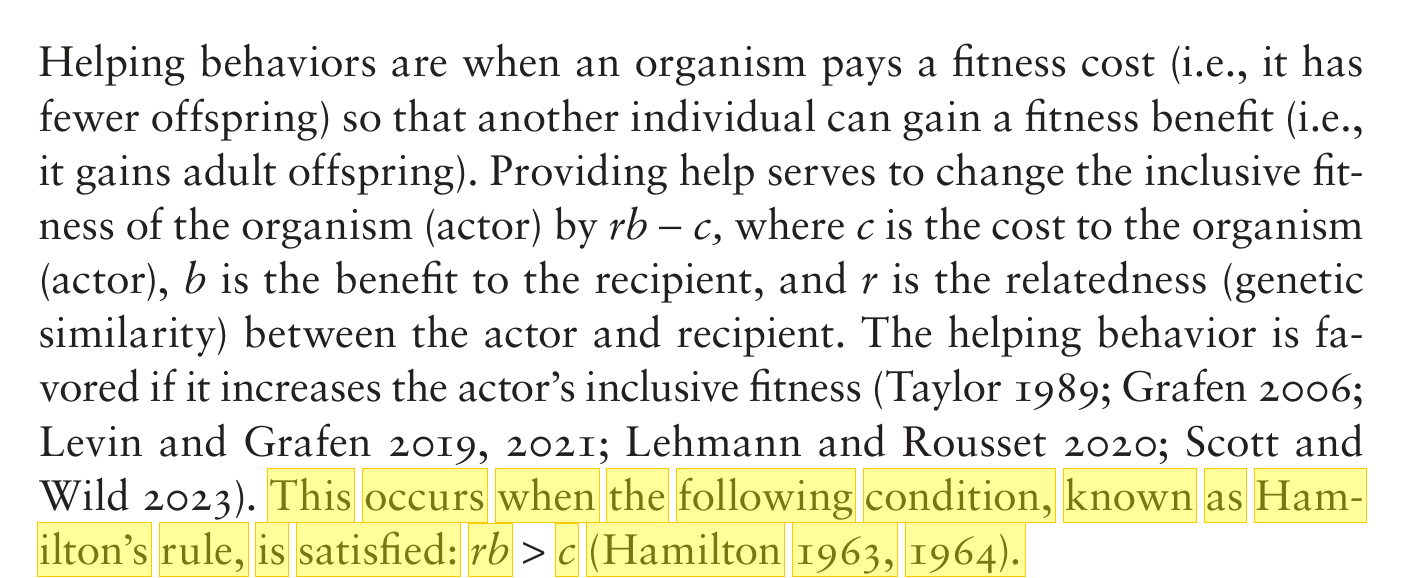
agren2025-p15-b4-bcc0129360.png “Providing help serves to change the inclusive fitness of the organism (actor) by rb − c, where c is the cost to the organism (actor), b is the benefit to the recipient, and r is the relatedness (genetic similarity) between the actor and recipient… This occurs when the following condition, known as Hamilton’s rule, is satisfied: rb > c (Hamilton 1963, 1964).”
- Grafen A (1985). “A geometric view of relatedness”. Oxford Surveys in Evolutionary Biology. 2: 28–89. ↩↩2↩3↩4↩5
- Cressler CE, McLeod DV, Rozins C, Van Den Hoogen J, Day T (2016). “The adaptive evolution of virulence: a review of theoretical predictions and empirical tests”. Parasitology / Philosophical Transactions of the Royal Society B (Leggett HC, Brown SP, Reece SE 2014, “War and peace: social interactions in infections”). 369 (1642): 20130365. doi:10.1098/rstb.2013.0365↩↩2↩3Info
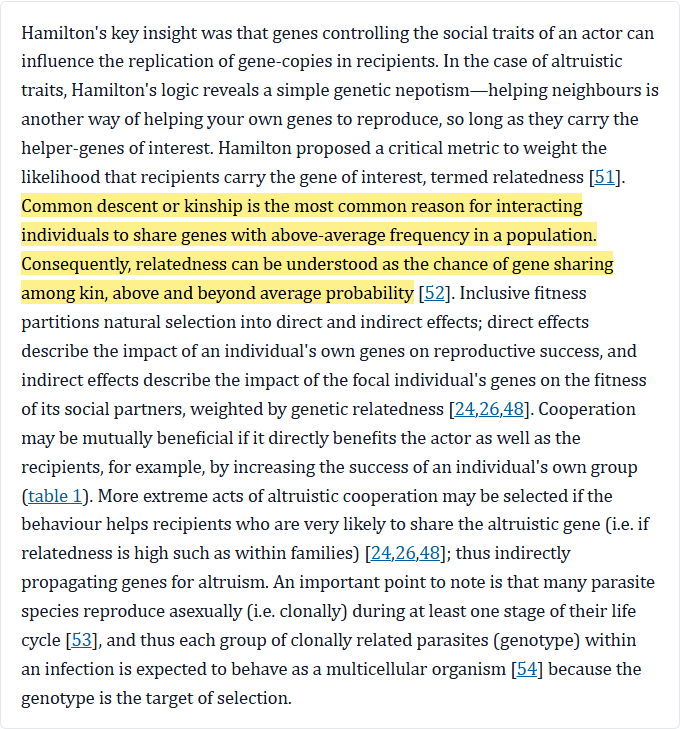
hamilton_relatedness2014-html-f0065a2855.png “Common descent or kinship is the most common reason for interacting individuals to share genes with above-average frequency in a population. Consequently, relatedness can be understood as the chance of gene sharing among kin, above and beyond average probability [52].”
- Strassmann JE, Queller DC (2011). “Evolution of cooperation and control of cheating in a social microbe”. Proceedings of the National Academy of Sciences. 108 (Suppl 2): 10855–10862. doi:10.1073/pnas.1102451108↩↩2Info
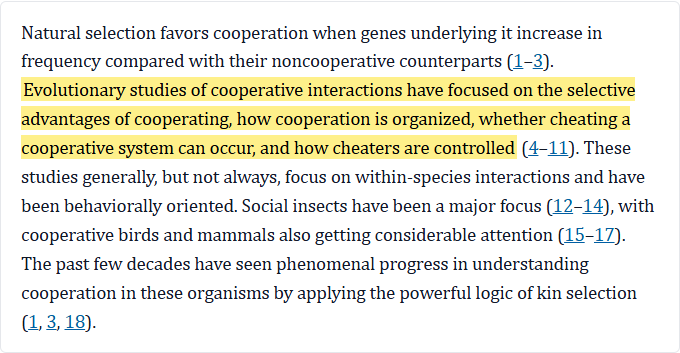
strassmann2011-html-32f1f15011.png “Evolutionary studies of cooperative interactions have focused on the selective advantages of cooperating, how cooperation is organized, whether cheating a cooperative system can occur, and how cheaters are controlled.”